
How to Handle the “It’s Too Expensive” Objection in Solar & Heat Pump Sales
When a homeowner says, “It’s too expensive,” many sales representatives instinctively start defending the price.
They might explain the quality of the equipment, the experience of the installation company, the potential savings or everything included in the quotation. All of those things may be relevant, but there is a problem with jumping straight into the response.
The salesperson doesn't yet know what the homeowner means by "too expensive".
For a homeowner considering a solar or heat pump installation, the concern could be the upfront cost, the expected return on investment, or whether they would rather spend the money on something else. These are completely different concerns, and each requires a different conversation.
That is why handling the “it’s too expensive” objection starts before the actual answer. The first job of the salesperson is to understand what is behind the objection.
Brad's objection-handling framework, which is used in sales training for heat pump and solar sales, puts clarifying questions at the beginning of the process for exactly this reason.
Why “It’s Too Expensive” Doesn't Tell You Enough
Price objections can sound straightforward because the homeowner appears to have given you a clear reason for hesitating.
In reality, the statement is vague.
A homeowner could be looking at a £10,000 installation and thinking that they simply don't have £10,000 available. Another homeowner could have the money but be unsure whether the expected savings justify the investment. Someone else might be comparing your quotation with another purchase they are considering for their home.
The words are identical, but the underlying problem is different.
Brad specifically uses the example of a customer saying that a system is too expensive to demonstrate why salespeople need to establish what the customer actually means. The concern could relate to upfront cost, return on investment or another competing purchase.
This is why the first response should not necessarily be a rebuttal.
It should be a clarifying question.
Start by Understanding What the Customer Means
Clarifying questions are simple, but they have an important role in the sales process.
If the homeowner says the installation is too expensive, the salesperson needs to establish what part of the cost is creating the problem. There is little value in delivering a detailed explanation about return on investment if the homeowner's actual problem is that they cannot afford the upfront payment.
In that situation, finance options may be much more relevant.
Likewise, if the homeowner is questioning whether the system represents a worthwhile investment, a conversation around projected savings, payback or the financial case may be more appropriate.
The important point is that the salesperson should not decide what the objection means on the customer's behalf.
Brad explains that asking one or several clarifying questions can make the eventual response significantly better because the salesperson understands the actual concern they need to address.
This also prevents another common sales problem: giving a technically good answer to the wrong question.
Don't Rush Into Defending the Price
Once a salesperson hears a price objection, it can be tempting to prove that the quotation is justified.
They might start explaining why the company is better than competitors, why the equipment is higher quality, how much the homeowner could save, or why the installation is worth the money.
The information might all be valid. The problem is that the conversation can quickly become too sales-focused.
Brad's framework recommends diffusing an objection before trying to handle it. The purpose is to make the homeowner feel comfortable raising concerns and asking questions rather than making them feel as though they have triggered an immediate sales response.
For example, when a prospect says they need to think about something, Brad recommends acknowledging the statement rather than immediately challenging it.
The same principle applies to price.
A homeowner considering a major purchase should be able to say that the price concerns them without feeling that the salesperson is immediately going to try to talk them out of it.
That creates a better starting point for the actual discussion.
Empathy Makes the Conversation More Consultative
After acknowledging the concern, the salesperson should demonstrate empathy.
This is not about agreeing that the system is overpriced. It is about recognising that the homeowner has a legitimate reason to think carefully about a significant financial decision.
A solar or heat pump installation can represent a substantial amount of money. It is reasonable for a homeowner to want to understand what they are getting for that investment and whether it makes sense for their circumstances.
Brad's approach is deliberately consultative. He explains that salespeople need to avoid coming across as though they are simply trying to get a commission or close a sale. Showing genuine empathy can increase trust and make the eventual response more effective.
This changes the tone of the conversation.
Instead of trying to "beat" the objection, the salesperson is helping the homeowner understand the decision they are considering.
The Response Needs to Match the Actual Concern
Once the salesperson knows what the homeowner means by "too expensive", the response should be focused on that specific issue.
This is where concise responses become important.
A common mistake is to over-explain. The salesperson knows a lot about solar or heat pumps, so when an objection comes up, they may try to explain everything that makes the system a good investment.
But the homeowner didn't necessarily ask for everything.
They raised one particular concern.
Brad explains that sales reps should avoid a two-to-five-minute explanation about all the things that make solar systems appealing. Instead, the response should address the precise issue the homeowner has raised.
Consider three different versions of the same objection.
If the homeowner cannot afford the upfront cost
The relevant discussion may be around available finance options.
If the homeowner is unsure about the return
The relevant discussion may involve the expected savings, payback or financial calculations for their system.
If the homeowner is comparing your price with another quotation
The salesperson may need to explain the differences between the proposals and what is included.
The answer should follow the problem.
That sounds obvious, but it is much easier to do when the salesperson has taken the time to clarify the objection first.
Show the Customer Instead of Just Telling Them
Financial objections are also an opportunity to use evidence.
If a homeowner questions whether solar represents a worthwhile investment, simply saying that it will save them money requires them to take the salesperson's word for it.
Where relevant information is available, showing the homeowner the figures can make the explanation much more tangible.
That could include savings calculations, graphs, energy data or other figures relevant to the proposal.
Brad specifically recommends showing customers evidence where possible rather than simply telling them why their concern is wrong. He notes that numbers, graphs and data can make the explanation more convincing and real for the customer.
This is particularly useful when the objection involves misinformation or uncertainty.
Rather than asking the homeowner to accept a broad statement such as "it's a good investment", the salesperson can demonstrate the reasoning behind the recommendation.
The homeowner can then see how the numbers relate to their own situation.
Use a Confidence Loop After the Response
Once the specific objection has been addressed, Brad's framework adds a confidence loop.
The idea is to finish the response with a short statement that reinforces confidence in the answer.
For example, after addressing a concern about whether a heat pump will perform effectively, the salesperson might reinforce why the proposed system is suitable for the property.
The confidence loop isn't supposed to replace the explanation. It comes after it.
This matters because homeowners considering a £5,000, £10,000 or £15,000 purchase may understand the information they have been given but still want reassurance that they are making the right decision.
Brad explains that a confidence loop can raise the customer's conviction level and make them feel more secure about the decision.
The confidence should come from the information that has already been established rather than from unsupported promises.
Don't Assume the Objection Has Been Resolved
After answering the concern, the salesperson still has one important job: find out whether the homeowner is actually satisfied with the response.
This is the pulse check.
A simple question such as "Does that clear things up?" or "Does that give you more confidence?" gives the salesperson immediate feedback about whether the explanation has worked.
The important part is to listen to more than the words.
A homeowner might say "Yeah, that's fine" simply because they don't want to disagree with the salesperson. That response is very different from someone who confidently says that the explanation has cleared up their concern.
Brad specifically highlights the importance of listening to the customer's tone as well as their words.
That can help the salesperson identify concerns that are still sitting underneath the conversation.
What to Do When the Customer Still Sounds Unsure
Sometimes the pulse check produces an answer that doesn't sound convincing.
A homeowner might say that the explanation "sort of" clears things up, but their tone suggests that they still have reservations.
At that point, the salesperson can gently challenge the response.
The objective isn't to confront the homeowner. It is to give them another opportunity to explain what is still bothering them.
Brad recommends using this stage to open the conversation back up when the customer's response doesn't match their tone. The salesperson can offer to explain the issue in more detail or ask whether there is anything else they want clarified.
This is valuable because an unconvincing "yes" may actually mean the original objection hasn't been handled properly.
Rather than moving forward and hoping the concern disappears, the salesperson can find out what is still missing and respond again.
The “It's Too Expensive” Objection in Practice
Imagine a homeowner has just received a quotation for a solar installation and says:
"I like the system, but it's too expensive."
The salesperson's first job isn't to explain the benefits of solar.
It is to understand the statement.
If the homeowner explains that they simply don't have enough money available upfront, the conversation can move towards the relevant finance options.
If they say they have the money but aren't convinced about the return, the salesperson can focus on the financial case and show the relevant numbers.
If they say another installer is £2,000 cheaper, the salesperson now knows that the concern relates to the comparison between quotations and can explore what is different between the two proposals.
The same sentence led to three different conversations.
That's why having a framework is more useful than memorising one response to the phrase "it's too expensive".
A Practical Framework for Handling Price Concerns
The process can be summarised as follows:
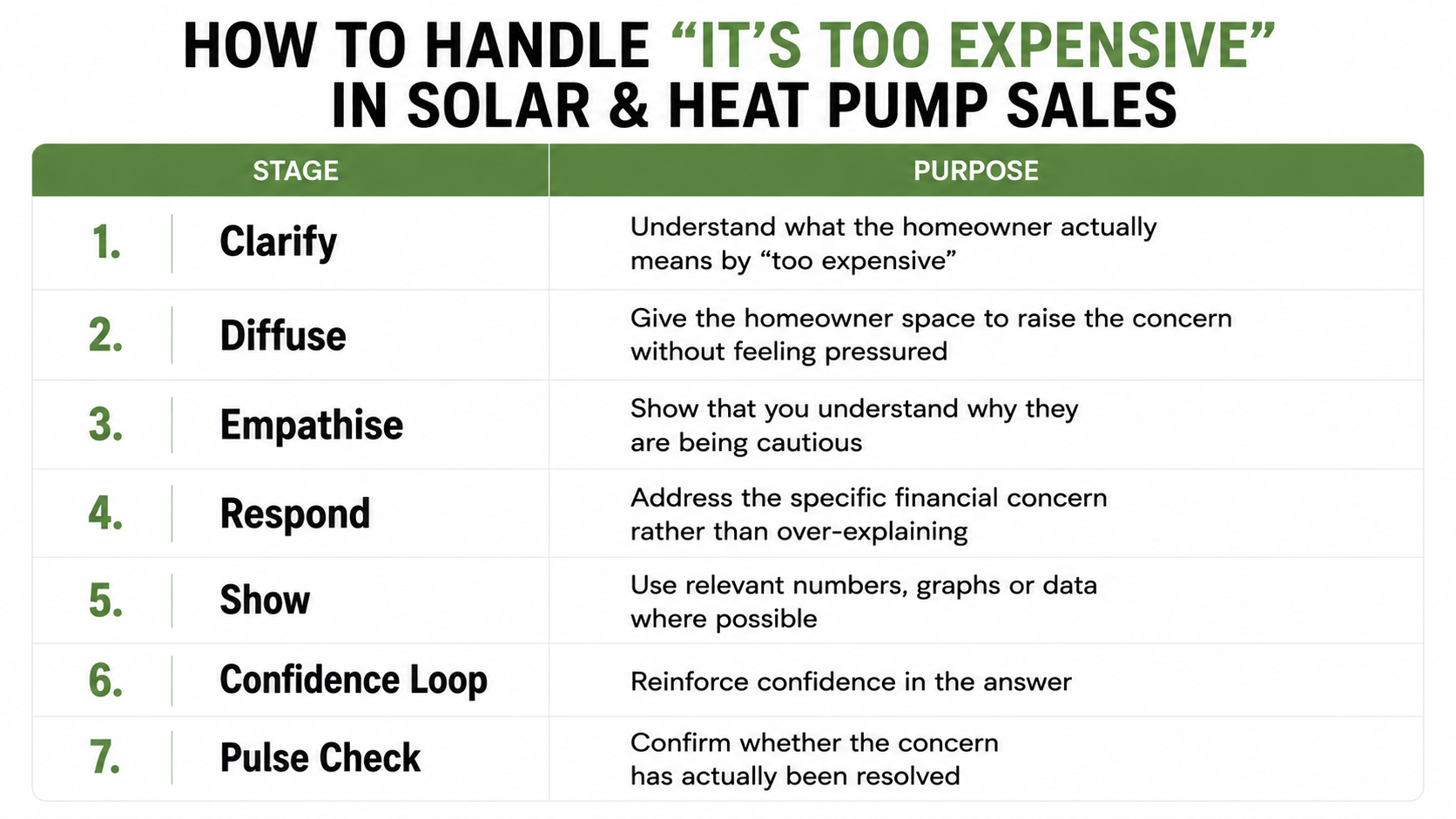
Why the Wrong Response Can Make a Price Objection Worse
The biggest danger with a price objection isn't necessarily having a poor answer.
It is having a good answer to the wrong problem.
If the homeowner cannot afford the upfront cost, explaining the long-term return on investment doesn't solve the immediate issue.
If they are worried about the return, talking about finance doesn't answer their concern.
And if they are comparing your quotation with another installer, discussing generic benefits of solar may not explain why your proposal costs more.
This is why clarification has such an important role in the framework.
The salesperson needs to understand the concern before deciding what information will actually help.
It also explains why over-explaining can be counterproductive. Brad's framework specifically recommends keeping responses concise and targeted rather than trying to cover every benefit of the product in one conversation.
Scripts Have a Place, But They Aren't Enough
There is still value in having prepared responses for common objections.
Price is one of the obvious examples. "I need to think about it" is another.
Brad recommends having specific scripts available for common objections, but also explains why sales reps need a broader framework for questions they haven't been trained to answer with a specific script.
A framework gives the salesperson something to fall back on.
Even when the customer raises an unexpected question, the salesperson can still clarify the concern, respond appropriately and check whether the answer has resolved it.
That makes the framework useful beyond a single price objection.
It becomes part of the overall sales process.
The Bigger Lesson for Solar and Heat Pump Sales Teams
A homeowner raising a price concern isn't necessarily telling you they don't want the product.
They may be asking for more information before they feel comfortable making a significant financial decision.
That means the salesperson's job is not simply to convince them that the price is justified.
The salesperson needs to understand what is stopping them from being comfortable with the investment.
Sometimes that will require a financial explanation. Sometimes it will require evidence. Sometimes it will reveal a completely different concern.
The framework provides a consistent way to work through those situations without forcing every homeowner into the same scripted response.
And because the same framework can be applied to other questions and objections, it gives sales teams something more flexible than a collection of memorised rebuttals.
Conclusion
The “it’s too expensive” objection doesn't have one universal answer.
Before responding, a sales representative needs to understand what the homeowner actually means. The concern could be upfront affordability, return on investment, another financial priority or a comparison with a competing quotation.
Once that is clear, the response can be much more useful.
The salesperson can acknowledge the concern, demonstrate empathy and give a concise answer that addresses the specific issue. Where relevant, numbers, graphs and other evidence can make the explanation more tangible. A confidence loop can then reinforce the answer, followed by a pulse check to establish whether the homeowner is genuinely satisfied.
If they aren't, the conversation shouldn't simply move on. A hesitant response may indicate another concern that needs to be uncovered.
Ultimately, handling price objections well isn't about finding a clever way to convince someone that an expensive product is cheap.
It's about understanding why the customer thinks it's too expensive, then giving them the information they need to make the right decision.
This objection-handling framework is part of the wider sales training InstallrHub provides to installers, alongside its core service of ready-to-quote appointments for heat pump and solar installers.
Want to improve how your sales team handles objections?
Find out more about InstallrHub and its sales training and lead generation services.