
Why Good Sales Reps Ask Questions Before Answering Homeowner Objections
A homeowner raises an objection.
The salesperson immediately starts answering.
It sounds helpful, but there is a problem: they may not actually know what the homeowner is asking.
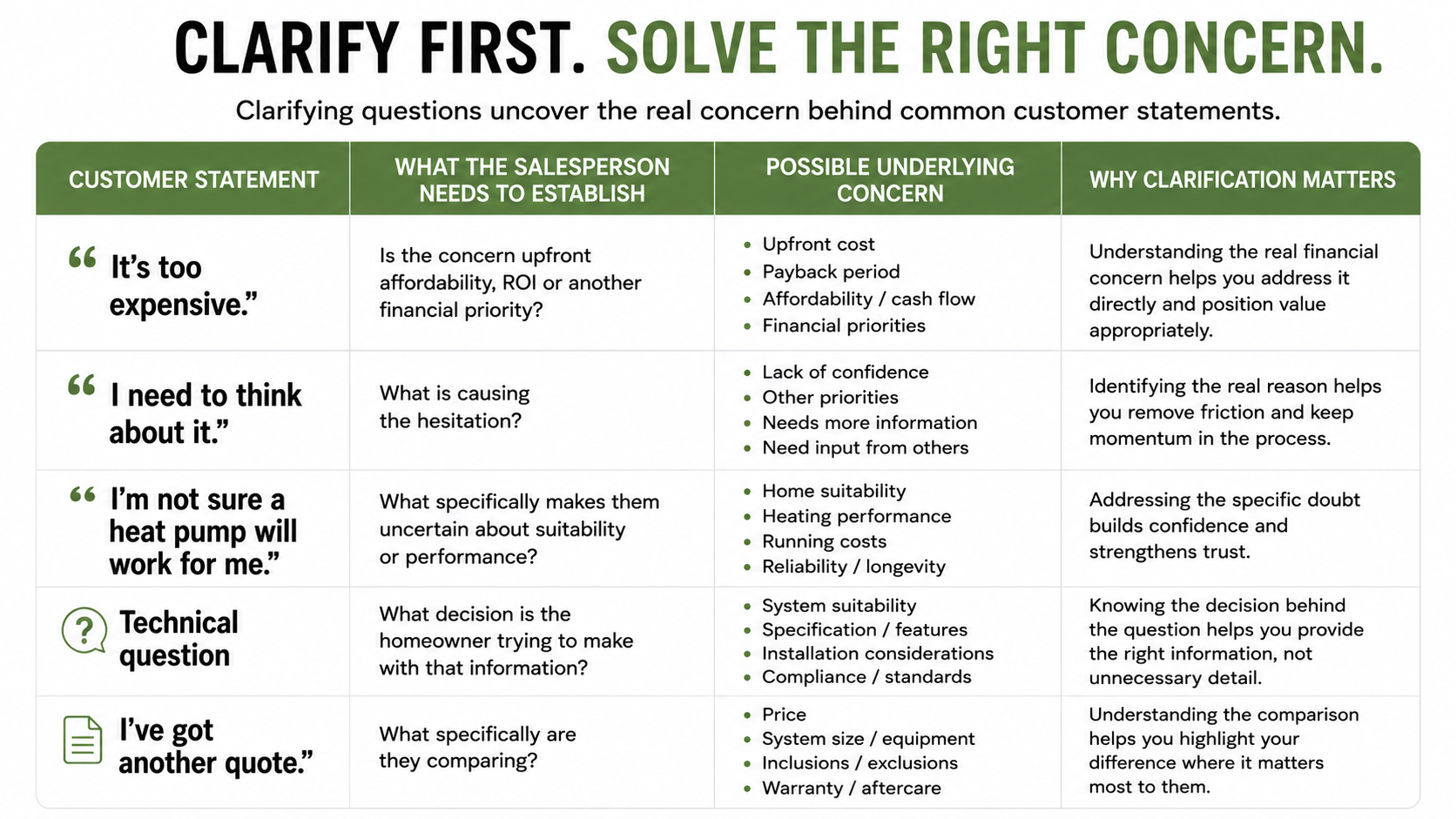
This is particularly common with vague objections. A homeowner might say that a solar installation is too expensive, that they need to think about it, or that they aren't sure whether a heat pump is right for their property. Each statement gives the salesperson some information, but not necessarily enough to know what is actually stopping the customer from moving forward.
That is why sales objection clarifying questions are such an important part of the sales process.
Before giving an answer, the salesperson needs to understand the question behind the question.
Brad's objection-handling framework for solar and heat pump sales puts clarifying questions at the beginning for exactly this reason. The salesperson needs to fully understand what the homeowner is asking or objecting to before deciding how to respond.
Why Answering Too Quickly Can Backfire
When a homeowner raises an objection, there is a natural instinct to respond immediately.
The salesperson may already have a prepared answer. They may have dealt with a similar concern dozens of times before. They may know exactly what they want to say.
But familiarity with an objection doesn't necessarily mean you understand what this particular customer means by it.
Consider the phrase:
"I think it's too expensive."
That could mean the homeowner doesn't have enough money available upfront. It could mean they aren't convinced that the system will generate a sufficient return. They might be comparing the purchase with another planned expense.
The appropriate response changes depending on which of those concerns is actually behind the statement.
Brad uses this exact example in the framework, explaining that "expensive" can mean several different things and that the salesperson needs to establish what the customer means before responding.
Without that clarification, a salesperson can easily spend several minutes explaining something the homeowner wasn't concerned about in the first place.
The Difference Between Hearing an Objection and Understanding It
Hearing what a homeowner says is not necessarily the same as understanding their concern.
A salesperson might hear:
"It's too expensive."
and mentally translate that into:
"They don't see the return on investment."
But the homeowner might actually mean:
"I don't have £10,000 available right now."
Those two situations require completely different conversations.
If the salesperson responds with a detailed explanation of projected savings, they may technically be giving good information, but it isn't information that solves the customer's immediate problem.
Brad explains that if the homeowner's concern is the lack of upfront cash, a conversation about finance options is likely to be much more relevant than discussing ROI.
This is why clarifying questions can make the eventual response significantly better.
The salesperson isn't asking questions for the sake of asking questions.
They're gathering enough information to make sure the answer is actually useful.
What Makes a Good Clarifying Question?
A useful clarifying question should help identify what sits underneath the initial objection.
The salesperson may need only one question, or they may need several.
Brad's framework doesn't prescribe one fixed question for every situation. Instead, the principle is to ask whatever is necessary to understand the customer's actual objection or question.
For example, if a homeowner says the installation is too expensive, the salesperson could explore whether their concern is about the upfront payment, the expected return, or another factor.
The important thing is that the question should move the conversation towards understanding rather than immediately trying to persuade.
This also requires the salesperson to listen carefully to the answer.
If the homeowner gives a more detailed explanation, that information should influence the response that follows.
Clarification Makes the Response More Targeted
The biggest benefit of asking questions before responding is that it allows the salesperson to be concise.
This might sound contradictory. Surely asking more questions makes the conversation longer?
Sometimes it does.
But a few seconds spent establishing the real concern can prevent a much longer, unfocused explanation.
Brad specifically connects the clarifying stage with the next part of his framework: the concise response. If the salesperson doesn't understand the actual objection, they cannot deliver a concise and targeted answer.
Instead, they may start talking about all the reasons why solar systems are good, how the technology works, the company's experience, potential savings and everything else they think might help.
The homeowner may still be sitting there thinking about the original issue.
Clarification prevents this.
Once the salesperson understands the actual concern, they can focus only on the information that matters.
A Price Objection Is a Good Example
Price is one of the clearest examples of why sales objection clarifying questions matter.
Imagine two homeowners both say:
"That's too expensive."
The first homeowner has enough savings to pay for the installation but doesn't believe the projected savings justify the investment.
The second homeowner thinks the system makes sense but cannot comfortably pay the full amount upfront.
The first conversation might need to focus on the financial return.
The second might need to focus on finance options.
If the salesperson assumes both homeowners have the same objection, they will inevitably give at least one of them the wrong response.
That is precisely why Brad recommends clarifying the meaning behind "too expensive" before moving into the response.
Clarification Also Applies to Questions, Not Just Objections
This principle isn't limited to obvious sales objections.
Homeowners ask questions throughout a solar or heat pump consultation.
They might ask how a particular system works, whether it will suit their property, what the installation involves or what kind of savings they can expect.
A salesperson can still benefit from understanding what prompted the question before launching into an explanation.
Sometimes a seemingly technical question is actually connected to a different concern.
For example, a homeowner asking whether a heat pump can replace their boiler may not simply be interested in the technical mechanics. They could be trying to work out whether the technology is suitable for their home.
Understanding the context helps the salesperson decide how much information is actually needed.
Clarifying Questions Prevent Over-Selling
One of the reasons salespeople can become overly salesy is that they start explaining everything they know.
The homeowner raises one concern.
The salesperson responds with a five-minute explanation covering every benefit of the product.
Brad specifically warns against this approach. The response should be concise, targeted and focused on the precise question or objection the homeowner has raised.
Clarification acts as a natural control mechanism.
Once you know the problem, you have a reason to stop talking about everything else.
If the homeowner is concerned about affordability, you can address affordability.
If they are concerned about ROI, address ROI.
If they are unsure about suitability, address suitability.
The conversation becomes more relevant because the salesperson has a clear problem to solve.
Clarification Also Helps Build Trust
There is another benefit to asking questions before answering: it can make the homeowner feel listened to.
A salesperson who immediately responds may give the impression that they are waiting for an opportunity to deliver their pitch.
A salesperson who takes the time to understand the concern demonstrates that they are actually listening.
This fits into the wider framework Brad describes, where salespeople are encouraged to take a consultative approach and show that they are looking out for the customer's best interests.
Clarifying questions alone don't create trust.
But they can contribute to a conversation in which the homeowner feels that the salesperson is responding to their situation rather than simply following a sales script.
Clarification Is Only the First Part of the Framework
Clarifying questions are important, but they aren't intended to be the entire objection-handling process.
Brad's wider framework places them alongside several other stages.
After understanding the objection, the salesperson can diffuse it, demonstrate empathy, give a concise response, reinforce confidence and then check whether the concern has actually been resolved.
The reason clarification comes first is straightforward: every stage that follows depends on understanding the actual concern.
If the salesperson gets that first part wrong, the rest of the response is likely to be wrong as well.
From Clarification to a Better Response
Once the homeowner has explained the concern, the salesperson can finally decide what information is relevant.
This is where the response becomes much more precise.
If the customer is worried about upfront affordability, the salesperson can address the relevant payment or finance options.
If they're questioning the financial return, the salesperson can use the appropriate figures, graphs or calculations.
If they're concerned about whether the system will work for their property, the salesperson can focus on the relevant technical information.
Brad also recommends showing the customer evidence where possible rather than simply telling them why their concern shouldn't matter. Numbers, graphs and data can make the explanation more convincing and tangible.
The common thread is relevance.
The customer has raised a specific concern, and the salesperson is now equipped to address that concern properly.
What Happens When the Salesperson Gets It Wrong?
Sometimes the salesperson will clarify the objection and still give an answer that doesn't fully resolve it.
That's why the framework includes a pulse check.
After responding, the salesperson can ask whether the explanation makes sense or whether it has cleared things up.
The customer's response provides immediate feedback.
If the answer sounds hesitant, the salesperson can explore the issue further rather than simply moving on.
Brad explains that if a customer says something along the lines of "that sort of clears it up" but doesn't sound convinced, the salesperson should challenge the response in a non-confrontational way and give the customer an opportunity to explain what remains unresolved.
This creates a useful feedback loop.
Clarify the concern.
Respond to it.
Check the response.
If it hasn't landed, find out why.
Then respond again.
The Role of Scripts
Sales scripts can still be useful.
There are common objections that sales teams will encounter repeatedly, and having a prepared response can give representatives more confidence.
But scripts cannot cover every possible question a homeowner might ask.
That's why Brad recommends having specific scripts for common objections while also giving sales reps a broader framework that they can use when they encounter something unexpected.
This is particularly useful for less experienced salespeople.
Instead of freezing because they don't have a scripted response, they have a process they can follow.
They can ask questions until they understand the issue, then use the information they've gathered to build a relevant response.
Why This Matters for Solar and Heat Pump Installers
Solar and heat pump sales involve enough complexity that homeowners will naturally have questions.
The challenge for a sales team isn't to prevent those questions.
It is to make sure representatives know how to respond when they arise.
A salesperson who answers every objection immediately may sound confident, but confidence isn't the same as relevance. If the response doesn't address the customer's actual concern, the homeowner is unlikely to feel any more comfortable.
Clarifying questions create a short pause between the objection and the response.
That pause gives the salesperson an opportunity to understand what is really happening and gives the homeowner an opportunity to explain what they need.
The result is a more targeted conversation and, potentially, a much more useful sales interaction.
Conclusion
Good salespeople don't necessarily have an answer ready the moment a homeowner raises an objection.
They first make sure they understand the question.
That is the fundamental reason sales objection clarifying questions matter.
A statement such as "it's too expensive" can describe several completely different concerns. Without clarification, the salesperson is forced to guess which one they're dealing with. That can lead to a long explanation that sounds persuasive but fails to address what is actually holding the homeowner back.
By asking the right questions first, the salesperson can make the eventual response more concise, more relevant and more useful. It also supports the wider consultative approach Brad recommends, where the salesperson is trying to understand the customer's situation rather than simply pushing towards a sale.
And if the first response doesn't work, the framework provides another opportunity to check, challenge and understand what remains unresolved.
The objective isn't to ask questions instead of selling.
It is to ask enough questions to know what you're actually selling against.
Clarifying questions are one part of the wider sales training InstallrHub provides to installers, alongside ready-to-quote appointments for heat pump and solar installers.
Want to improve the way your sales team handles homeowner questions and objections?