
How to Use Proof to Handle Solar & Heat Pump Sales Objections
When a homeowner raises an objection, there are two ways a salesperson can respond.
They can tell the customer why the concern isn't something to worry about, or they can show them the information that supports the answer.
For higher-value purchases such as solar and heat pumps, the second approach can make a significant difference. A homeowner considering spending £5,000, £10,000 or £15,000 on a system has a reasonable interest in understanding why the proposed solution makes sense for their property.
This is where sales objection proof becomes useful. Rather than relying entirely on confident statements, the salesperson can use relevant numbers, graphs and data to demonstrate the reasoning behind the recommendation.
Brad's objection-handling framework specifically recommends showing the customer where possible rather than simply telling them. The aim is to make the answer more convincing and real by giving the homeowner something concrete to evaluate.
Why Telling Isn't Always Enough
A confident salesperson might say that a solar installation will be a good investment.They might explain that a particular heat pump is capable of performing well in cold weather.They might reassure the homeowner that the proposed system is suitable for the property.
The problem is that these statements are coming from the person trying to sell the system.Even when the claims are accurate, the homeowner still has to take the salesperson's word for them.That is why evidence can strengthen the conversation.
Instead of simply saying that the investment will be worthwhile, the salesperson can show the homeowner the relevant financial information. Instead of simply saying that a system will perform effectively, they can use appropriate information to demonstrate why the proposed solution is suitable.
Brad's framework describes this as showing the prospect rather than simply telling them. The distinction is particularly important when the homeowner's objection is based on uncertainty.
The Evidence Needs to Match the Objection
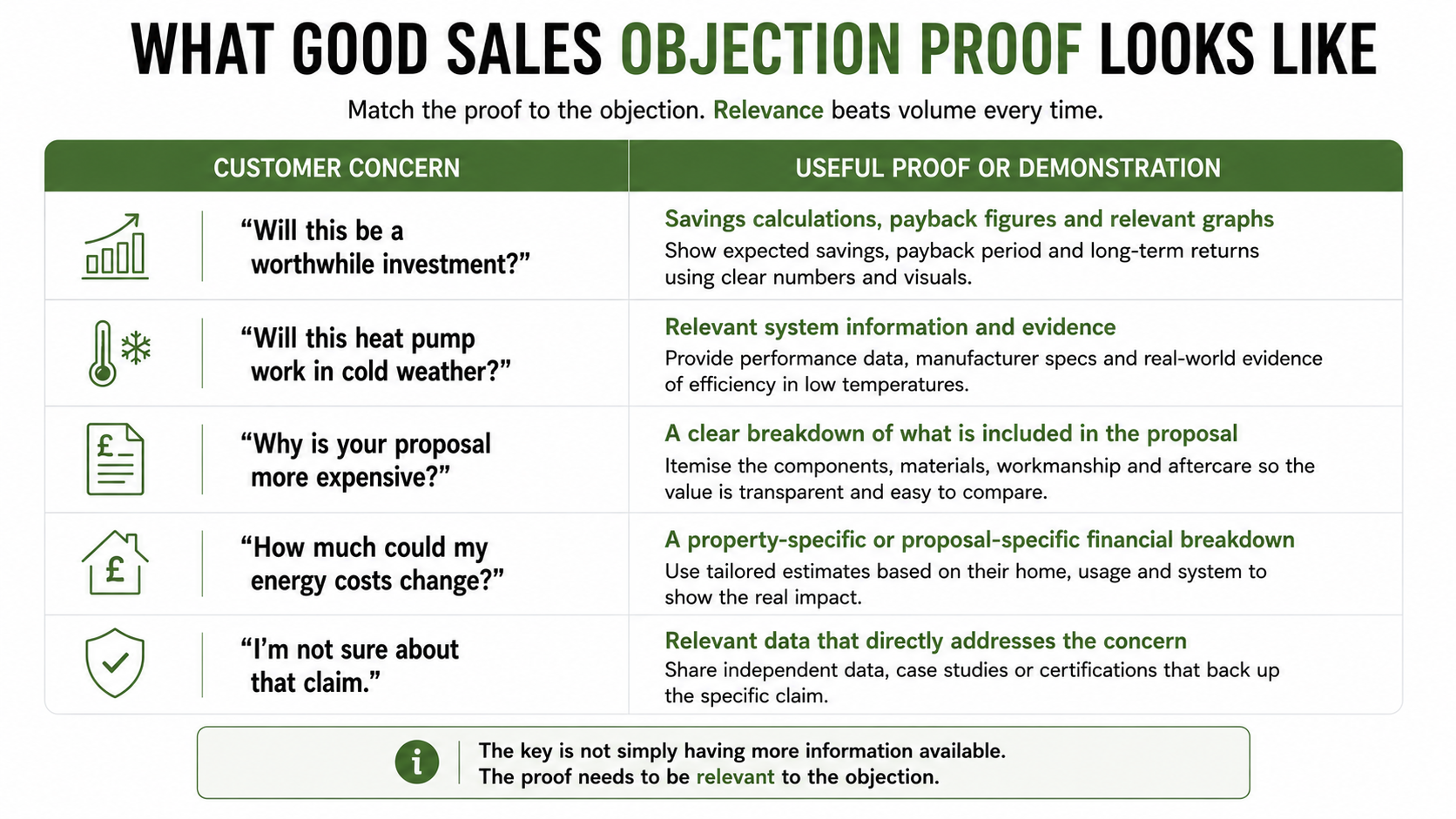
Using proof does not mean showing the homeowner every number available.The evidence needs to relate directly to the concern they have raised.This is why proof comes after understanding the objection.
If a homeowner says a solar installation is too expensive, the salesperson first needs to establish what "expensive" actually means. The concern could be the upfront cost, whether the investment will generate an acceptable return, or whether the homeowner is weighing the purchase against another expense.
Only then can the salesperson decide what evidence is relevant.
If the concern is return on investment, the useful information might include projected savings and payback.If the concern is upfront affordability, a graph showing long-term savings isn't necessarily going to solve the immediate problem. The conversation may need to focus on the relevant finance options instead.
The principle is simple: the evidence should answer the question the homeowner actually has.
Financial Objections Are an Obvious Place to Use Data
Return on investment is one of the clearest examples.A homeowner may be interested in solar but unsure whether the investment will pay for itself quickly enough to justify the cost.
Simply telling them:"It's a good investment."doesn't give them much to work with.A stronger approach is to demonstrate the financial case.
Brad suggests using a graph or presentation that can show information such as how much the homeowner's energy bill could fall, what the payback period looks like and what the savings could be after the payback period.
The homeowner can then see how the recommendation relates to their own situation.This also gives the salesperson something more useful to discuss. Instead of arguing over whether solar is "worth it", the conversation can focus on the actual figures.
Showing the Numbers Makes the Conversation More Tangible
There is a psychological difference between hearing a claim and seeing information.
If a salesperson says:"You'll save money."the homeowner has to imagine what that means.If the salesperson can show a clear breakdown of the projected costs, savings and payback, the homeowner has something concrete in front of them.
Brad specifically explains that numbers, graphs and data can make the response more convincing and real for the customer. This does not mean the data will automatically convince every homeowner.
It simply gives the customer better information with which to evaluate the decision.That distinction matters.
The salesperson's job isn't to manufacture certainty. It is to provide a clear explanation supported by the information available.
Proof Also Helps With Technical Questions
The same principle applies beyond financial objections.Consider a homeowner who is concerned about whether a heat pump will work effectively during cold weather.A salesperson could simply reassure them that it will work.
Brad uses this type of scenario when explaining the confidence loop. The salesperson can explain why the specific system is suitable for colder conditions and reinforce that the concern should not prevent the customer from proceeding. Where relevant evidence is available, showing that information can make the response stronger.
The homeowner isn't being asked to accept reassurance purely because the salesperson sounds confident.
They are being given information that supports the explanation.The same approach can apply to other technical questions, provided the evidence is genuinely relevant to the customer's concern.
Proof Works Best When the Objection Has Been Properly Clarified
This is one of the reasons the stages of the objection-handling framework work together.
A salesperson cannot give a highly targeted response if they don't understand the objection.
Brad makes this connection explicitly. Clarifying questions are important because understanding exactly what the customer means allows the salesperson to provide a much more targeted response.
For example, suppose a homeowner says:"I'm not sure this is going to be worth it."That could mean several things.
Perhaps they're questioning the financial return.Perhaps they are unsure about the lifespan of the equipment.Perhaps they have been given conflicting information by another installer.Perhaps they simply don't understand how the technology works.
Showing them a savings graph might be useful in the first situation and almost irrelevant in the others.
The proof becomes powerful because it is connected to the specific concern.
Don't Overload the Homeowner With Information
There is also a danger in using proof badly.More data does not automatically mean a better sales conversation.
If a homeowner asks one specific question and the salesperson responds with ten graphs, several pages of calculations and a long technical explanation, the original concern can become harder to understand.
Brad's framework therefore emphasises concise responses. The goal is to handle the objection in as few words as possible while focusing on the main information the customer actually needs.
The same principle applies to evidence.Show the information that helps answer the question.Don't bury the answer under information that isn't relevant.
A clear graph showing the financial calculation may be more useful than five pages of figures the homeowner has no reason to interpret.
Proof and the Confidence Loop Work Together
Evidence doesn't replace confidence.It supports it.Once the salesperson has addressed the customer's concern with relevant information, the confidence loop can reinforce the conclusion.
Brad describes the confidence loop as a short phrase added to the end of the response to reinforce that the customer has nothing to worry about, that the system will work or that the investment makes sense, depending on the objection.
The sequence therefore becomes important.
First, understand the concern.Then provide the relevant response.Where possible, show the evidence.Then reinforce the conclusion.That is much stronger than simply repeating the same reassurance.
An Objection Can Increase Confidence
Objections are often treated as bad news.A salesperson hears a question and immediately thinks they need to overcome a barrier. Brad takes a different view.
He explains that objections and questions can actually be an opportunity to increase the customer's conviction. When an objection is handled correctly, it can increase the customer's trust in the salesperson as an expert and increase their confidence that the proposed solution is the right decision. That changes the way the salesperson should think about evidence.
The purpose isn't to find a graph that "wins" the argument.It is to help the homeowner understand the issue well enough to make an informed decision.
If the evidence resolves their concern, their confidence may increase.If it doesn't, the salesperson has learned that another concern still needs to be addressed.Either way, the conversation becomes more useful.
What Happens After You Show the Evidence?
The salesperson should still check whether the answer has worked.This is where the pulse check comes in.
After explaining the concern and showing the relevant information, the salesperson can ask whether it makes sense or whether it has cleared things up.
Brad recommends this check because a customer's verbal response doesn't always tell the whole story. Their tone can indicate whether they are genuinely convinced or simply giving a polite response. If the homeowner confidently confirms that the explanation has cleared up the concern, the salesperson can move forward.
If the homeowner gives a hesitant response, there may still be another issue underneath the original objection.
That is where the optional challenge stage can become useful.
When the Customer Still Doesn't Sound Convinced
A homeowner might respond:"Yeah, that sort of clears it up."
Technically, that is a positive response.But if their tone suggests uncertainty, the salesperson shouldn't necessarily assume the objection has been resolved.
Brad recommends gently challenging this type of response rather than ignoring it. The salesperson can offer to explain the point in more detail or ask whether there is anything else they would like clarified.
This is not about confronting the homeowner.It is about finding out whether the salesperson has actually done enough.If another concern emerges, the salesperson can return to the relevant part of the framework and address it.If the homeowner confirms that everything is clear, the salesperson has greater confidence that the original objection has genuinely been handled.
Proof Should Support the Sales Conversation, Not Replace It
Data is useful, but it shouldn't become a substitute for listening.
A salesperson could have an excellent financial presentation and still fail to address a homeowner's concern if they don't understand what the customer is asking.That is why proof sits within the wider objection-handling framework rather than operating as a standalone technique.
The framework begins with understanding the objection. It then moves through diffusion, empathy and a concise response before using a confidence loop and pulse check. Showing the customer the relevant evidence is recommended where possible throughout the response.
Each part has a different purpose.The questions establish the problem.
Empathy reduces unnecessary resistance.The response addresses the problem.The evidence demonstrates the answer.The confidence loop reinforces it.The pulse check establishes whether it has actually worked.
Why This Matters for Installer Sales Teams
Solar and heat pump installers are selling complex, high-value solutions.
Their sales representatives therefore need more than product knowledge. They need a process for helping homeowners understand why a particular recommendation makes sense.
That becomes particularly important when the homeowner raises an objection.
A salesperson who responds entirely through verbal reassurance can quickly find themselves in a situation where the customer is being asked to trust the person selling the product.
A salesperson who can explain the issue and demonstrate the relevant information gives the homeowner something more tangible to consider.
This is also why Brad's framework is designed to work alongside specific objection scripts. Scripts can help with common situations, but a broader framework gives sales reps something to follow when the customer asks an unexpected question or raises an objection they haven't been specifically trained to handle.
The objective isn't to turn every sales appointment into a presentation.
It is to make sure the salesperson can demonstrate the answer when simply explaining it isn't enough.
Building Proof Into the Sales Process
The most effective way to use evidence is to prepare it before the sales appointment.
If a particular objection comes up frequently, the sales team should know what information can help address it.
For financial questions, that might mean having clear savings and payback calculations available.
For technical questions, it could mean having relevant product or system information ready to demonstrate.
For proposal comparisons, the salesperson may need to be able to explain the differences between installations or quotations clearly.
This doesn't mean every homeowner should receive the same presentation.
The information should be selected based on what the individual customer is actually concerned about.
That brings the process back to the first stage of the framework: understanding the objection before responding to it.
Conclusion
Effective objection handling isn't about having the most persuasive sentence.
It is about giving the homeowner a clear reason to feel confident in the decision they are considering.
That is why sales objection proof can be so useful for solar and heat pump sales.
When a homeowner questions the return on investment, relevant financial figures can make the explanation tangible. When they question technical performance, appropriate evidence can support the salesperson's answer. When they question a price difference, a clear breakdown can help explain what they are actually comparing.
The important thing is that the proof must match the concern.
A salesperson should first understand what the homeowner is asking, then provide a concise response and show the relevant evidence wherever possible. The confidence loop can reinforce the answer, while the pulse check establishes whether the customer genuinely feels that their concern has been addressed.
If the customer still sounds uncertain, that is useful information rather than a failure. It gives the salesperson another opportunity to understand what remains unresolved.
Ultimately, the strongest sales conversations aren't built around telling homeowners what they should believe.
They are built around helping homeowners see why the recommendation makes sense.
This objection-handling framework forms part of the wider sales training InstallrHub provides to installers, alongside its core service of ready-to-quote appointments for heat pump and solar installers.
Want to improve the way your sales team handles homeowner objections?
Find out more about InstallrHub and its sales training and lead generation services.