Why We Sometimes Turn Down Homeowners Who Want A Survey
When renewable energy installers invest in lead generation, success is often measured by one number: how many surveys are booked each week. More appointments appear to create more opportunities, which should ultimately lead to more installations.
However, the reality is often more complex.
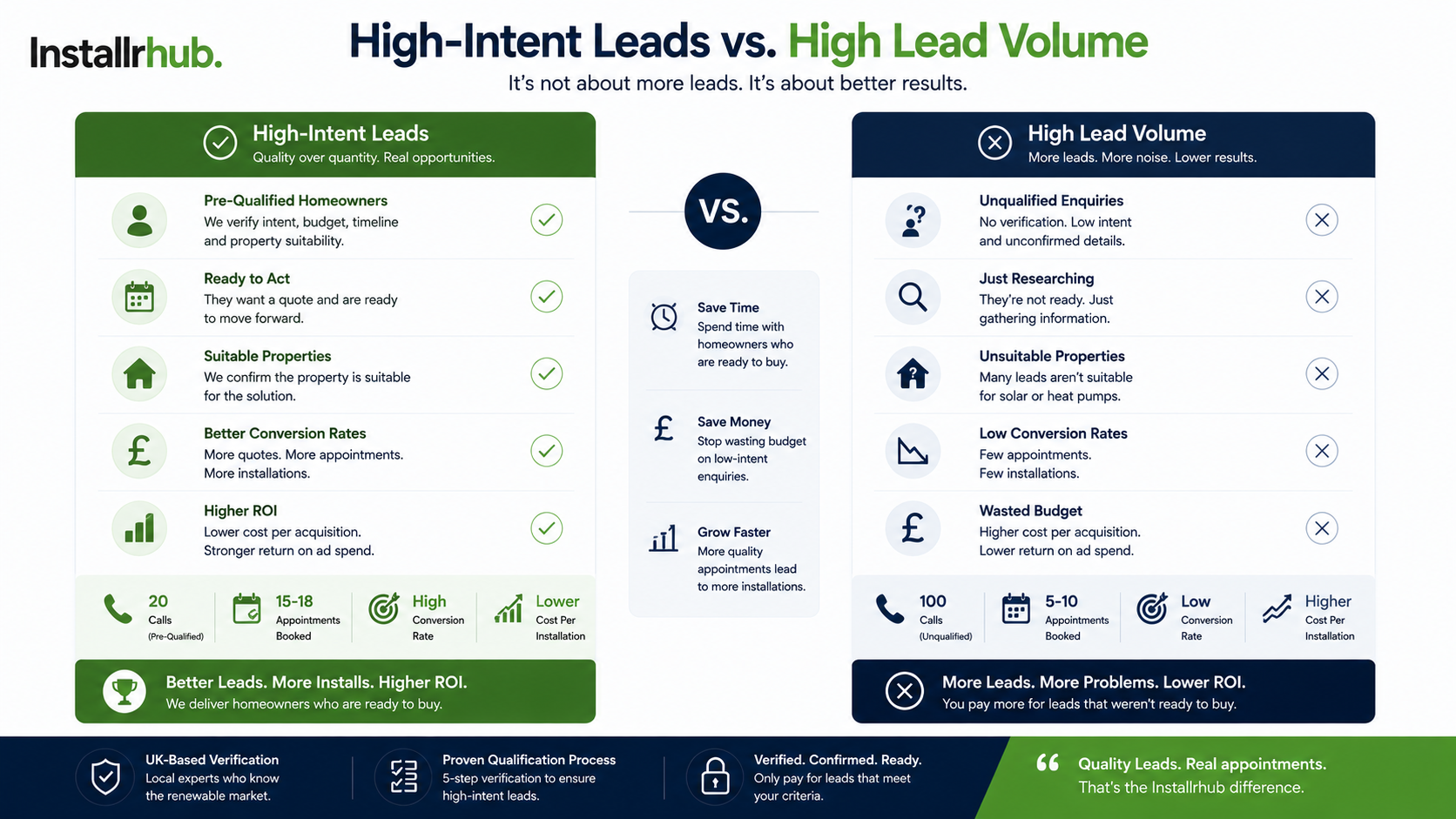
Not every homeowner who requests a survey is genuinely ready to proceed with a heat pump or solar installation. While booking every enquiry may create a full diary, it can also lead to wasted surveyor time, higher acquisition costs and fewer opportunities to meet homeowners who are genuinely prepared to move forward.
This is why, at InstallrHub, we occasionally make a decision that surprises installers and homeowners alike, we choose not to book a survey.
It isn't because we want fewer enquiries. It's because we believe the quality of a survey is far more important than the quantity of appointments booked. A carefully qualified survey gives installers a far greater chance of converting an opportunity into a completed installation, while protecting valuable time and operational resources.
Every Survey Is An Investment
Every survey booked represents a commitment of time, money and resources long before a surveyor arrives at a homeowner's property.
Marketing has already generated the enquiry. Administrative staff have coordinated appointments. Sales teams have invested time speaking with the homeowner, and surveyors have allocated space in their schedules. Add travel time, fuel costs and vehicle expenses, and it becomes clear that every survey carries a real financial cost.
For many installation businesses, survey capacity is one of the most valuable resources they have.
When a survey is booked for a homeowner who has little intention of proceeding—or whose circumstances make an installation unrealistic—that opportunity is lost. More importantly, another homeowner with stronger purchase intent may have to wait longer for an appointment or choose another installer altogether.
This is why survey qualification should never be viewed as a simple administrative step. It is a key part of improving sales efficiency and protecting profitability.
Wanting A Survey Doesn't Always Mean Someone Is Ready To Buy
One of the most common misconceptions in renewable lead generation is that every homeowner who requests a survey is ready to make a purchasing decision.
In reality, homeowners enquire for many different reasons.
Some are actively searching for a replacement heating system after seeing their energy bills increase significantly. Others are comparing technologies before making a decision, while some are simply gathering information because they have recently heard about heat pumps or solar panels.
Although every enquiry deserves a professional response, not every enquiry should automatically progress to a survey.
The objective of lead qualification is not to reject interested homeowners. Instead, it is to understand whether there is a genuine problem that renewable technology can solve, whether the homeowner has realistic expectations, and whether the timing is appropriate for both parties.
By understanding these factors before a survey is booked, installers can spend more time with homeowners who are genuinely likely to proceed and less time attending appointments that were never likely to become installations.
Why Motivation Matters More Than Interest
A homeowner's level of interest is only one part of the qualification process.
What often matters more is why they made the enquiry in the first place.
Consider two homeowners.
The first explains that they are "just looking to see what's available."
The second says their oil heating costs have increased dramatically and they are actively looking for a more efficient long-term solution.
On paper, both homeowners have submitted an enquiry and both may happily accept a survey appointment. However, the second homeowner has identified a clear problem that they want to solve. They have a defined motivation, making the conversation significantly more productive for both the installer and the customer.
Understanding this difference is one of the most effective ways to improve survey quality and overall conversion rates.
Looking Beyond Basic Qualification
Many lead generation providers still rely on basic qualification criteria before passing an enquiry to an installer. Typical questions often include whether the individual owns the property, the type of home they live in or whether they have sufficient space for a renewable energy system.
While these questions are important, they only establish whether a homeowner is technically eligible. They do not indicate whether that homeowner is genuinely likely to proceed with an installation.
Effective lead qualification goes much further.
Rather than simply confirming eligibility, it aims to understand the homeowner's circumstances, expectations and motivation. Questions such as:
- Why are you considering a heat pump or solar panels now?
- What prompted your enquiry?
- What are you hoping to achieve from the installation?
- Have you researched your options already?
- Are you planning to make a decision in the near future?
provide far greater insight into the quality of an opportunity than basic eligibility checks alone.
The answers to these questions help build a clearer picture of whether the enquiry is likely to become a productive survey or simply another appointment that consumes valuable time without producing meaningful results.
Protecting Your Installers' Time

Every installation business operates with limited resources.
Surveyors have a finite number of appointments they can complete each week, and every hour spent travelling to or attending an unsuitable survey is an hour that cannot be invested elsewhere.
This is where poor qualification begins to affect more than just individual appointments.
An unnecessary survey may result in:
- Lost survey capacity
- Increased fuel and travel costs
- Lower productivity for surveyors
- Delays in seeing genuinely qualified homeowners
- Reduced sales efficiency
- Higher customer acquisition costs
Individually, these may seem like relatively small issues. Collectively, however, they can have a significant impact on profitability over time.
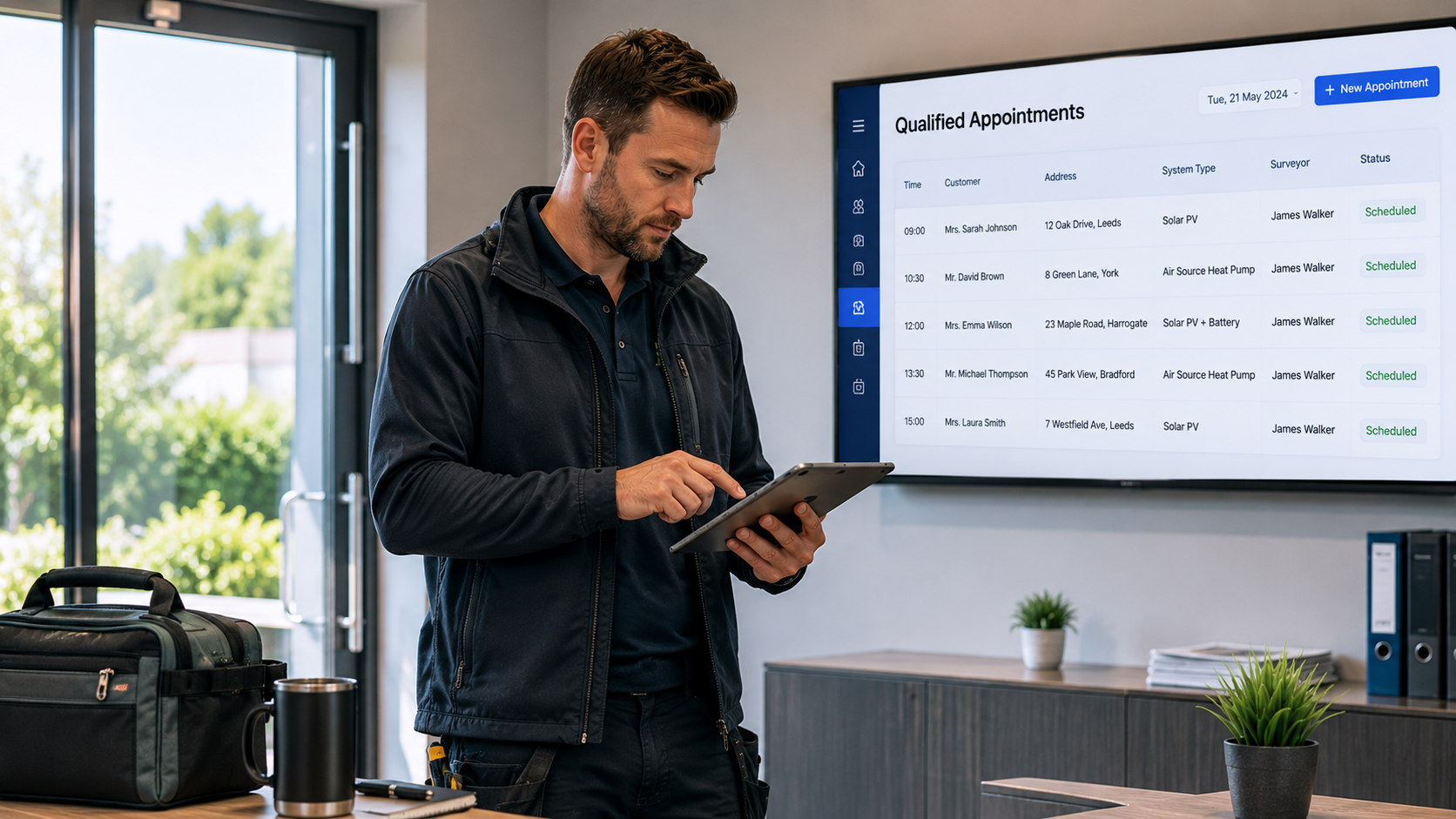
By ensuring surveys are booked only when there is genuine potential for an installation, businesses can make better use of their team's expertise while improving the experience for homeowners who are genuinely ready to move forward.
Saying "No" Can Create Better Results
At first glance, declining a homeowner's request for a survey may appear to be the wrong decision.
After all, every enquiry represents a potential opportunity.
However, not every opportunity creates value.
If qualification conversations reveal that a homeowner has no clear reason for enquiring, unrealistic expectations or no intention of making a decision within the foreseeable future, arranging a survey is unlikely to benefit either party.
The homeowner may not receive the outcome they were hoping for, while the installer commits valuable time and resources to an appointment with little chance of progressing.
In these situations, choosing not to book a survey is not about rejecting the homeowner.
It is about ensuring that installers spend their time where they can create the greatest value while allowing homeowners to continue their research until they are genuinely ready to explore a renewable energy solution.
For this reason, successful lead qualification should never be measured by the number of appointments booked. It should be measured by the quality of those appointments and the opportunities they create for both installers and homeowners.
Better Questions Lead To Better Surveys
One of the defining characteristics of a strong lead qualification process is the quality of the conversation that takes place before a survey is ever booked.
Many providers focus on collecting enough information to pass an enquiry to an installer as quickly as possible. While this may increase the number of appointments booked, it does little to determine whether the homeowner is genuinely ready to proceed.
A more effective approach is to understand the motivation behind the enquiry.
Rather than treating qualification as a simple checklist, experienced lead generation teams take time to explore the homeowner's circumstances. Questions such as:
- What made you enquire about a heat pump or solar installation today?
- What are you hoping to achieve?
- What challenges are you experiencing with your current heating system?
- Have you already received quotations from other installers?
- When would you ideally like the installation completed?
These questions encourage homeowners to explain their objectives in their own words.
In many cases, the conversation reveals information that would never appear on an online enquiry form. A homeowner may explain that their heating costs have increased significantly, that an ageing boiler is becoming unreliable or that they want to future-proof their property before major renovation work begins.
Equally, the conversation may reveal that the homeowner is simply researching options with no intention of making a decision for many months.
Both situations are valuable.
The purpose of qualification is not to persuade every homeowner to proceed. It is to determine whether arranging a survey is the right next step for everyone involved.
Why This Approach Benefits Installers
For installers, better qualification creates benefits that extend well beyond higher conversion rates.
Surveyors spend more time with homeowners who have genuine purchase intent rather than travelling to appointments that are unlikely to progress.
Sales teams can focus their attention on meaningful conversations instead of following up enquiries that were never realistically going to become customers.
Business owners gain greater confidence in their forecasting because survey appointments are based on stronger opportunities rather than simple enquiry volume.
Perhaps most importantly, homeowners also benefit from this approach.
Rather than feeling pressured into arranging a survey before they are ready, they receive advice that matches their current stage of the buying journey. Those who require more information can continue researching, while those who are ready to move forward can be introduced to an installer with greater confidence.
The result is a more efficient process for everyone involved.
Final Thoughts
A full diary may look impressive, but it is not the best measure of successful lead generation.
The businesses that consistently grow understand that every survey represents an investment. Protecting that investment begins with asking better questions, understanding homeowner motivation and ensuring that appointments are booked only when there is a genuine opportunity to create value.
At InstallrHub, this philosophy sits at the heart of our qualification process.
Rather than measuring success by the number of surveys we book, we focus on helping installers spend their time with homeowners who have a genuine reason to move forward.
Because in renewable energy, profitable growth is not driven by more appointments.
It is driven by better ones.
Ready For Better Qualified Survey Leads?
Every enquiry tells a story—but only when the right questions are asked.
At InstallrHub, every homeowner goes through a structured qualification process before a survey is booked. We take the time to understand their goals, motivation and suitability, helping installers spend less time on unsuitable appointments and more time with homeowners who are genuinely ready to move forward.
If you're looking for qualified, pre-booked heat pump and solar surveys that prioritise quality over quantity, discover how InstallrHub can help improve your sales efficiency and make better use of your survey capacity.
Learn more about our qualification process and see how InstallrHub helps installers book better surveys—not just more surveys.