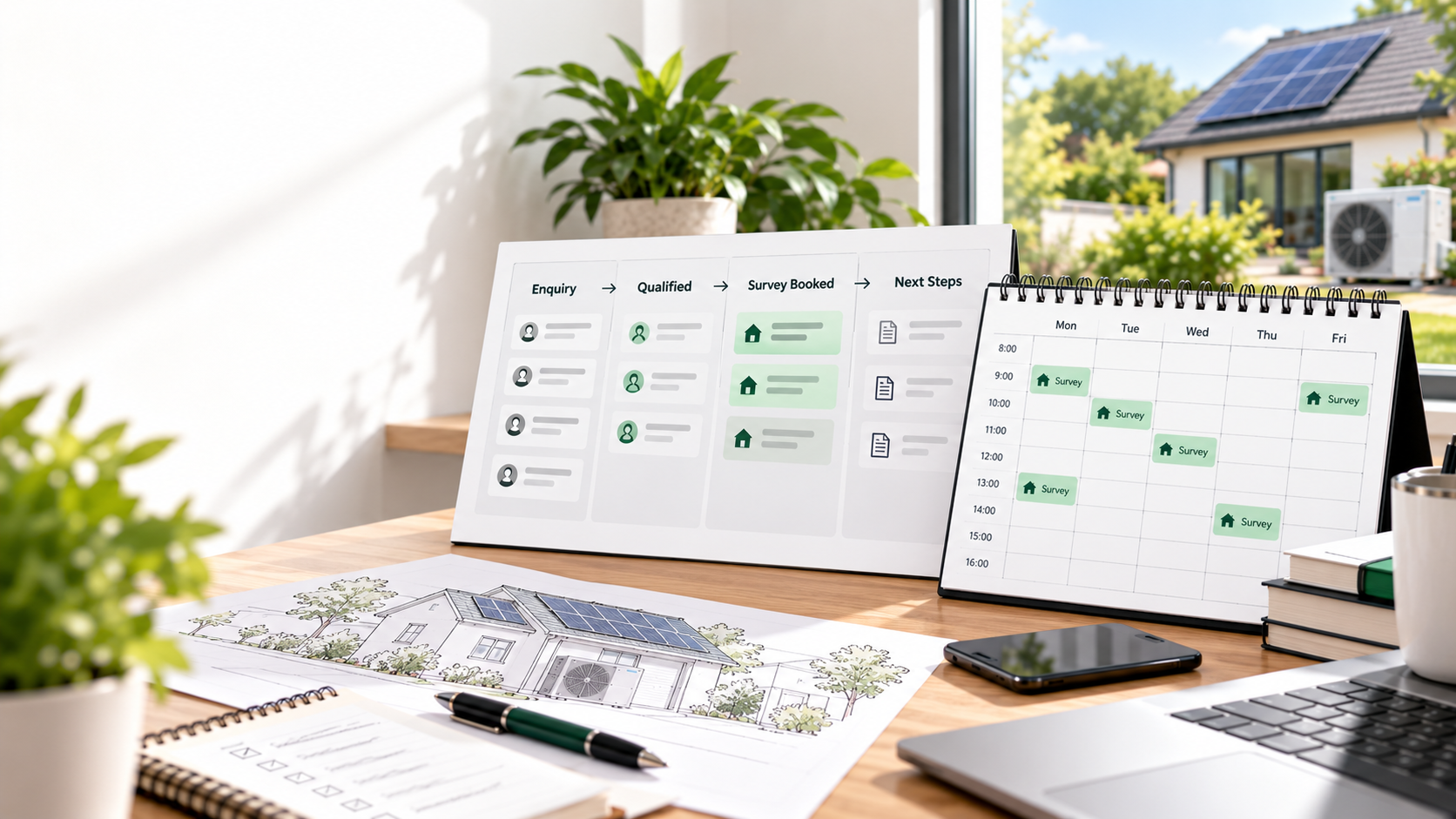
How to Grow Installer Leads Without Losing Control of Costs or Capacity
Generating more enquiries can help a solar or heat pump installation business grow, but only when the business can manage those opportunities effectively. Marketing activity needs to be matched to the areas the company serves, the type of customers it wants to reach, the speed at which it can respond and the number of installations it can deliver.
In an InstallrHub webinar, Brad Clark discussed how installers could prepare their businesses for potential changes in demand associated with the Warm Homes Loan Scheme. The discussion covered paid advertising, website SEO, local organic marketing, speed to lead, trust and the importance of matching marketing activity to operational capacity.
The key message was that installers should not simply wait for demand to arrive. They should build visibility and strengthen their customer journey while ensuring the business is ready to handle the work.
Why waiting for ready-to-buy customers can limit growth
Many installers compete for homeowners who have already researched solar or heat pumps, compared several companies and started requesting quotes. These customers may already have a shortlist, and the installer can become one more price in the inbox.
The webinar explored a different approach: reaching homeowners earlier in their buying journey, when they are beginning to research renewable technology or learning about available finance options.
That means helping potential customers understand the technology, the questions they should consider and the services the business provides before they are ready to request several quotes.
The timing matters because the first company a homeowner encounters is not guaranteed to win the job. However, being visible early creates an opportunity to build familiarity and trust before the customer makes a decision.
Installers can support this through educational content, relevant case studies, a useful website and marketing that reaches homeowners in the areas they actually serve.
Use the right mix of marketing channels
The webinar identified three broad approaches that installers could consider: Meta Ads, website SEO and local organic content. Each serves a different purpose, and the right mix will depend on the business's budget, location, capacity and existing online presence.
Meta Ads: Reach potential customers proactively
Paid social advertising can help a business introduce its services to homeowners who may not yet be actively requesting quotes. It gives the installer a way to test messaging and reach selected audiences within its intended service area.
However, an advertising campaign should not be judged solely by how many leads it generates. The business needs to examine whether the enquiries are relevant, whether they can be contacted and whether they progress into suitable appointments and installations.
During the webinar, Brad discussed an example of an installer that had previously received occasional solar enquiries through its existing electrical business. After working with InstallrHub on marketing and improving its website, the business was receiving enquiries from several channels, including Facebook forms and its website, with two or three surveys per day at the time described.
This was a specific business example, not a guaranteed outcome for every installer. The wider lesson is that marketing activity works alongside the website, the customer journey and the process used to handle enquiries.
Website SEO: Be visible when homeowners search
Homeowners researching solar, heat pumps or finance options may turn to search engines for answers. A website that clearly explains the company's services, service areas and approach can help prospective customers understand whether the business is relevant to them.
SEO is not just about adding a keyword to a page. The site needs useful information that matches what homeowners are trying to understand. That may include explanations of the technology, relevant project examples, answers to common questions and clear ways to contact the business.
The webinar encouraged installers to consider whether their websites would be ready to address the questions people might search for as awareness of the scheme developed. The underlying principle remains useful even when the timing or details of a scheme change: make sure the website helps potential customers understand the service and take the next step.
Local and organic content: Build visibility without relying entirely on paid leads
Installers with limited marketing budgets can also improve their local presence through consistent organic activity. The webinar highlighted approaches such as capturing case studies, setting up a Google Business Profile, participating appropriately in community groups and making it clear which services the business offers.
These activities may take time and do not guarantee a particular volume of enquiries. Their value is that they help establish a more complete online presence and provide homeowners with additional ways to discover and assess the business.
A useful starting point is to ensure that the company's website and local business profile are accurate, that genuine customer feedback is available and that the business can show examples of its work where it has permission to do so.
Speed to lead can influence the outcome
Visibility is only the first step. Once an enquiry arrives, the business needs a process for responding and moving the customer towards an appropriate next step.
The webinar compared two hypothetical installers. One contacts a new lead within minutes, qualifies the enquiry and arranges a survey promptly. The other waits days before calling and takes longer to send a quote. When customers have similar finance options available from different companies, the first installer may create a stronger impression simply by providing a quicker, more organised experience.
Brad recommended aiming to make the first phone call within five minutes of receiving an enquiry and moving from enquiry to survey and quote within days rather than weeks, where the circumstances allow.
These were recommendations discussed during the webinar, not guarantees that every lead can be processed within the same timeframe. The practical point is to measure response times and identify unnecessary delays.
InstallrHub also shared an example from its own appointment-booking operation: during September at the time of the webinar, its reported speed to lead was around four minutes, with approximately 40% of leads booked for a survey. Those figures describe the operation discussed in the presentation and should not be treated as universal industry benchmarks.
Build trust before the customer receives a quote
Fast follow-up helps, but speed alone will not win every job. Homeowners also need to feel confident in the company they are considering.
The webinar described how a more organised customer journey could include an introduction video of the engineer, relevant case studies, an FAQ pack explaining the survey and a professional proposal sent afterwards. These steps help set expectations and provide information at the stages when customers are likely to need it.
A business can also strengthen its credibility through genuine reviews, a professional website, a clear social media presence and consistent communication. The aim is to help homeowners understand who they are dealing with, what the process involves and what happens next.
The customer's experience should be consistent across marketing, sales and delivery. Promises made during an advert or sales conversation need to match what the business can actually provide.
Match marketing to your service area and installation capacity
Increasing lead volume without reviewing capacity can create new problems. A business may have enough staff to book surveys but not enough installation capacity to deliver the work promptly. It may also receive enquiries from outside its practical service area or for projects that do not fit its offering.
The webinar included an installer example where survey capacity and installation capacity were different, with the installation diary already booking ahead. It also discussed the longer-term ambition to grow, potentially through regional teams or partner companies.
These choices depend on the business. Before expanding into new areas or increasing advertising spend, installers should consider whether they can survey, quote and install the additional work to an appropriate standard.
Marketing activity can then be adjusted to match actual capacity. If the diary is full, the business may need to manage expectations, plan future availability or improve operational capacity before increasing demand further. If installation capacity is available, the business may have more room to test additional lead-generation activity.
The important point is to treat marketing and delivery as connected parts of the same business rather than separate functions.
Assess readiness before increasing the budget
The webinar ended this section of the discussion with a self-assessment covering visibility, speed and trust. Participants were encouraged to score themselves from one to five in each area, giving a total out of 15.
The exercise was intended as a prompt for honest reflection, not a formal industry certification. In the discussion, a score of nine to 12 or below was presented as a sign that the business may have gaps to address, while a score above 12 suggested it could be ready to focus more on proactive visibility. Those thresholds were guidance from the webinar, not independently validated benchmarks.
Installers can use the same general exercise to identify where to focus their efforts. Is the website helping homeowners find and understand the business? Are enquiries handled quickly? Does the customer journey build confidence? Are there sufficient resources to deliver the work being generated?
The answers can help the business decide whether the next step should be improving its website, reviewing advertising, strengthening follow-up or addressing delivery capacity.
Grow with a process, not just a bigger lead budget
A sustainable lead-generation strategy combines visibility, prompt follow-up, customer trust and the ability to deliver the work won. Meta Ads, SEO and local organic activity can each contribute, but none should be treated as a substitute for a clear sales process.
Before increasing spend, review the results from existing leads, identify where opportunities are being lost and make sure the business can handle additional demand. Then test improvements and measure what happens beyond the initial enquiry.
Want to assess your marketing, lead generation and sales foundations? Get your free Installer MOT from InstallrHub