How to Scale a Solar or Heat Pump Business Without Becoming the Bottleneck
Growing a solar or heat pump installation business is not simply a matter of generating more leads. As the number of enquiries and installations increases, the business also needs the people, systems and capacity to manage the additional work.
For owner-led installation businesses, this can become a difficult balancing act. The owner may be responsible for marketing, sales, customer communication and operational decisions while also managing the installation team. Growth can increase revenue opportunities, but it can also increase the number of decisions that depend on one person.
An InstallrHub webinar explored this challenge through a discussion about lead generation, installation capacity, sales processes and the difficulties of building a business that can operate consistently.
When the owner becomes the bottleneck
In a small installation business, it is understandable for the owner to manage most of the customer journey. They may handle the first conversation, arrange the survey, prepare the proposal, follow up and oversee the installation.
The difficulty arises when every stage depends on the owner's direct involvement. If they become unavailable, customer communication can slow down, decisions may be delayed and opportunities can be missed.
During the webinar, an installer described how difficult it was to take a holiday without a laptop because the business depended heavily on their involvement. This is a practical example of owner dependency: the business may be generating work, but too much of its day-to-day operation relies on one person.
The solution is not necessarily to hire a large team immediately. It is to identify which activities genuinely require the owner's expertise and which can be documented, systemised or delegated as the business becomes ready.
Build a repeatable customer journey
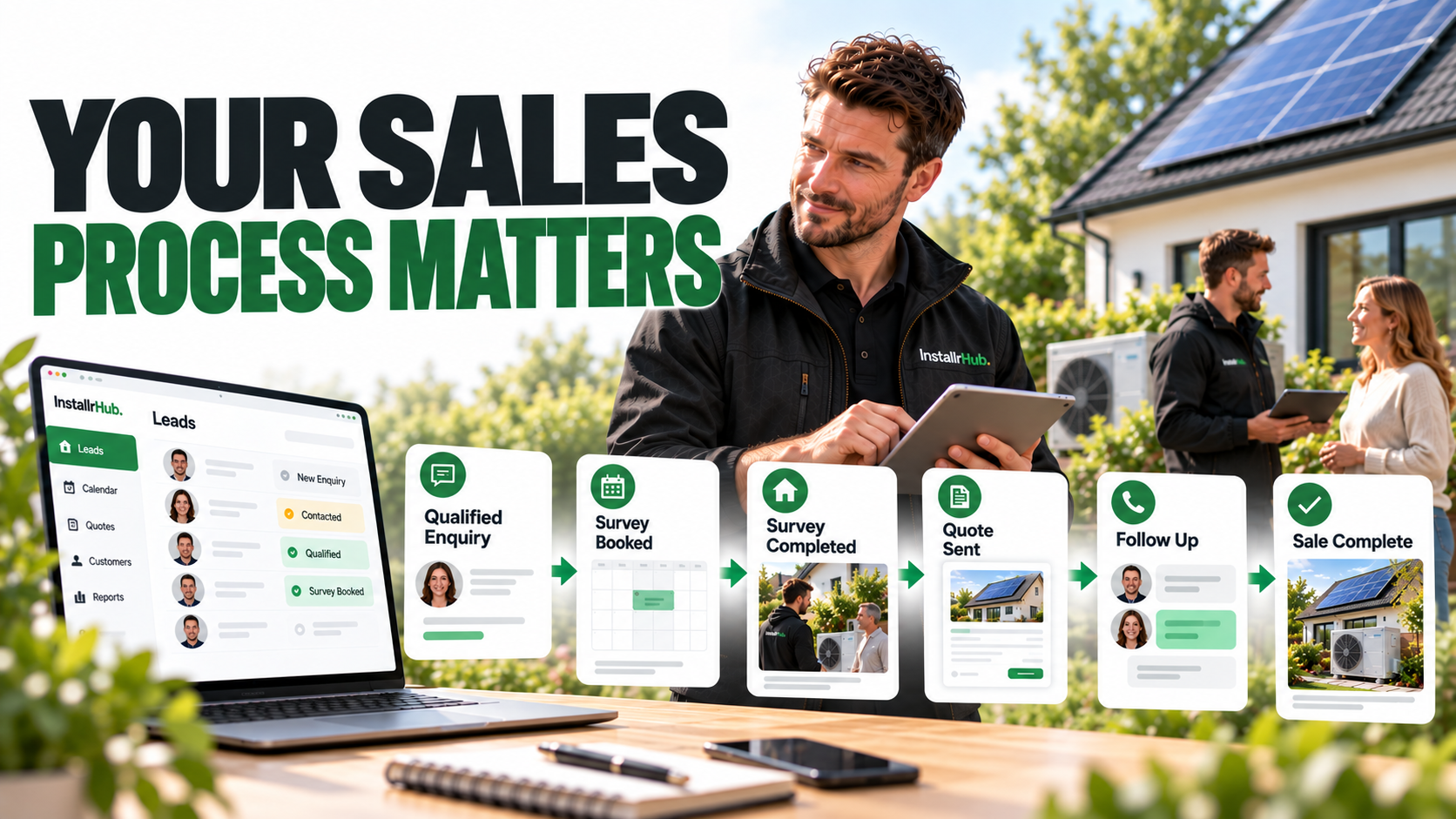
A repeatable customer journey gives the business a clearer way to manage each enquiry. It establishes what should happen from the first contact through qualification, appointment booking, survey, proposal, follow-up and installation.
Without a defined process, the experience may depend on who happens to handle the enquiry and how busy they are that day. Some customers may receive prompt communication and a clear proposal, while others wait longer or need to chase for updates.
A documented process makes it easier to maintain consistency. It can include response expectations, information to collect, appointment preparation, proposal delivery, follow-up responsibilities and the way customer information is recorded.
The process should remain practical rather than becoming a complicated manual that nobody uses. Its purpose is to make the right actions easier to repeat and to help the team understand who is responsible for each stage.
Use systems to reduce confusion
The webinar highlighted how customer communication can become difficult to manage when important details are scattered across channels such as WhatsApp. Messages can be missed, information may be hard to find later and other team members may not have the context needed to help the customer.
A more consistent system for recording enquiries, appointment details, follow-up actions and customer communication can reduce this problem. The specific tools will depend on the business, but the principle is the same: important customer information should not exist only in one person's memory or personal message history.
This becomes increasingly important when the business begins delegating sales or customer support. Another team member needs to understand the history of the enquiry, what has already been promised and what should happen next.
A good system should support the customer journey rather than create extra administration for its own sake.
Match lead generation to installation capacity
Scaling also means understanding the difference between generating demand and delivering installations.
In the webinar, the installer discussed having room for more surveys while installation capacity was approximately four installations per month at that point in time. The business was also dealing with a forward diary, illustrating how quickly demand can create pressure on delivery.
This does not mean that generating additional leads is inherently a problem. It means that lead generation, surveys, quoting and installation capacity need to be planned together.
If the business has unused installation capacity, additional suitable leads may be valuable. If the installation diary is already full, the priority may be improving qualification, setting clear expectations, planning future capacity or adjusting marketing activity to match the work the team can deliver.
The right balance will change over time. Capacity should be reviewed regularly rather than treated as a fixed number.
Decide how and where to expand
The webinar also explored the ambition to grow beyond the current operating model, including the possibility of developing regional teams or working with partner companies as part of a transition.
These are strategic options rather than automatic solutions. Each approach brings different requirements around quality control, customer experience, coordination and responsibility for the work.
Before expanding into a new area, an installer needs to consider whether there is sufficient demand, whether the company can serve the area effectively and how the work will be delivered. Expanding geographically without a clear delivery model may create additional complexity rather than sustainable growth.
Growth plans should therefore be connected to operational reality. The business needs to know not just where the next jobs might come from, but how those jobs will be surveyed, sold, scheduled and installed.
Make growth less dependent on the owner
A useful first step is to map the activities that currently require the owner's attention. Identify where enquiries stall when the owner is busy, which tasks are repeated manually and which decisions could be handled through a clear process.
Next, establish a consistent customer journey and record key information in a shared system. Review the number of surveys and installations the team can realistically manage, then align marketing activity with that capacity.
Delegation becomes easier when the process is understood and repeatable. It also becomes easier to identify the next role or resource the business actually needs, rather than hiring simply because the owner feels overwhelmed.
The aim is not to remove the owner from every part of the business. It is to build an operation where growth does not depend on the owner personally handling every enquiry, decision and customer interaction.
Strengthen the foundations before scaling
A growing installation business needs more than a steady flow of leads. It needs a customer journey that can be repeated, systems that support communication, and sufficient capacity to deliver the work it wins.
If your business is generating opportunities but too many decisions still depend on you, start by reviewing the process behind those opportunities.
InstallrHub's free Installer MOT can help you identify gaps across your marketing, lead generation and sales foundations.