What Makes a Good Solar or Heat Pump Lead? A Guide for UK Installers
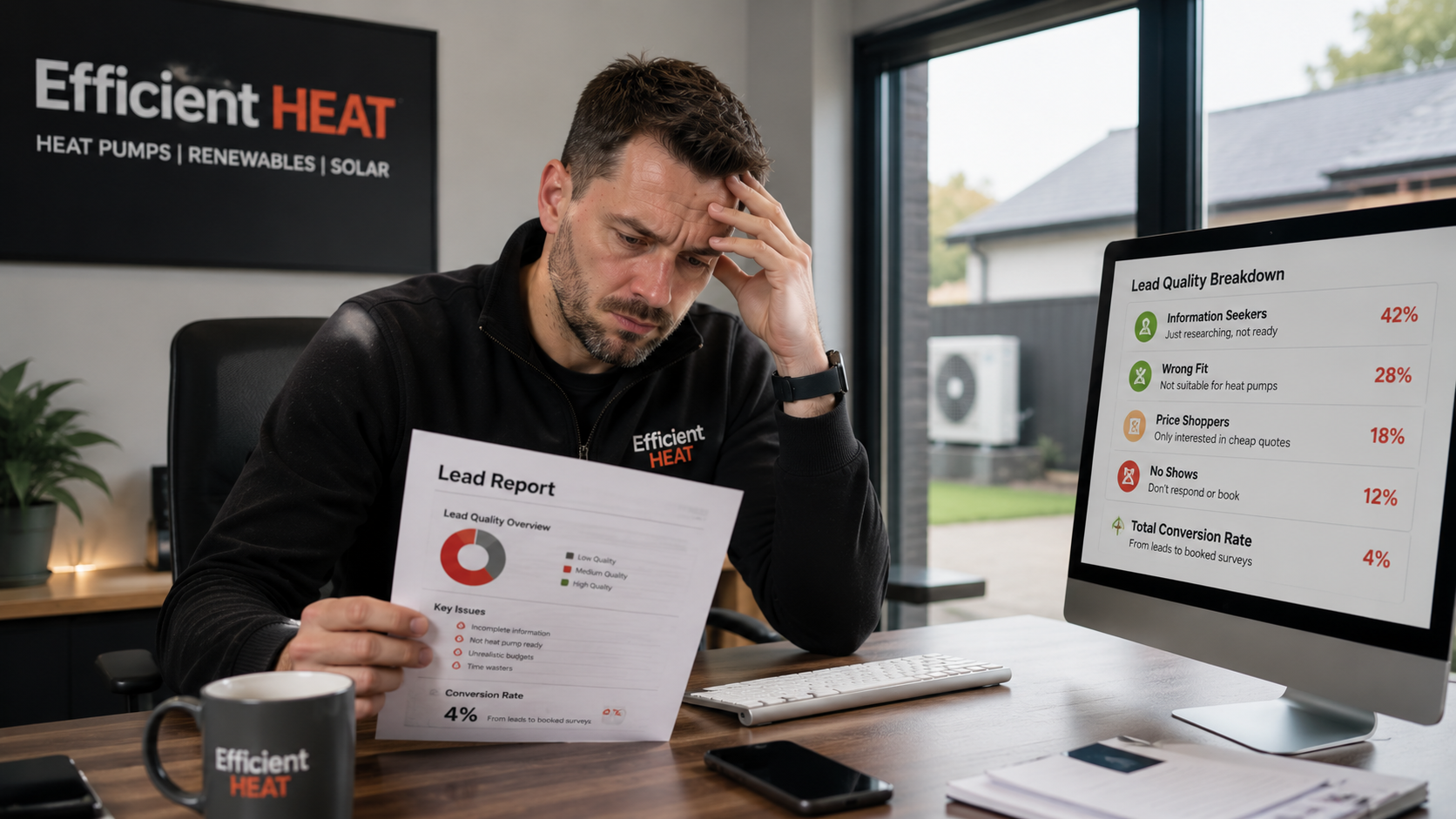
Generating enquiries is an important part of growing a solar or heat pump installation business, but the number of enquiries you receive does not necessarily tell you how much business they are likely to generate.
An enquiry might come from a homeowner who is actively comparing installation quotes, someone researching renewable energy for a future project, or a property owner who is interested in a system that may not suit their circumstances. All three may express an interest in solar panels or a heat pump, but they represent different opportunities for an installer.
This distinction matters because every enquiry requires some level of attention. Your team may need to make contact, understand the customer's requirements, gather property information, arrange a survey and prepare a quotation. When too many enquiries fail to progress, your sales team can spend a considerable amount of time pursuing opportunities that are unlikely to become installations.
For UK solar and heat pump installers, effective lead qualification helps bridge the gap between generating interest and creating a sales pipeline. It provides a structured way to assess whether an enquiry fits your services, understand what the customer needs and determine the most appropriate next step.
But what actually makes a lead good, and how can installers assess quality before committing valuable survey time?
Understanding Lead Quality in Solar and Heat Pump Installation
A good lead is not simply someone who has completed an online form or asked for more information about renewable energy. It is an enquiry that has a reasonable fit with your services and enough relevant information to justify further consideration.
For an installation business, that usually involves several connected factors: the customer's requirements, the property's potential suitability, their expectations, their timeframe and their willingness to engage in the process.
These factors should be considered together rather than treated as isolated boxes to tick. A homeowner may be genuinely interested in installing solar panels, for example, but live outside your service area. Another may have a suitable property but only be researching options for a project several months away. A third may be ready to proceed but need clarification about the likely cost and installation process.
None of these situations automatically makes an enquiry worthless. The important question is whether it represents a suitable opportunity now, needs further qualification or should be followed up at a later stage.
This is why lead quality cannot always be measured by a single characteristic. Installers need enough information to make an informed decision about how to handle each enquiry.
Property Suitability: Is the Enquiry Relevant to Your Installation Services?
Property suitability is one of the first considerations when assessing a potential solar or heat pump installation.
For solar PV, the roof's available space, orientation, shading, condition and the property's energy requirements may influence the eventual system design. Battery storage, electrical requirements and the customer's intended use of the system may also affect what needs to be assessed.
Heat pump installations involve a different set of considerations. The property's heating requirements, insulation, existing heating system, available space and other technical factors can influence the design and feasibility of the proposed installation.
Initial lead qualification should help identify relevant information about the property without attempting to replace a proper technical assessment. A marketing or sales team may be able to establish the property type, location, broad requirements and any known concerns, but some questions will need to be resolved by a suitably qualified professional.
This distinction is important. A lead qualification process should not promise that an installation is technically suitable before the necessary assessment has taken place.
Instead, the objective is to identify whether the enquiry appears relevant enough to progress. If the property falls within your service area and the customer's requirements align with the work your company undertakes, it may be appropriate to arrange a conversation or survey to investigate further.
By gathering the right information early, installers can reduce avoidable mismatches between customer enquiries and the services they provide.
Customer Intent: Interest Is Not the Same as Readiness to Buy
One of the most common challenges in lead generation is distinguishing general interest from an intention to take action.
A homeowner searching for solar panels may simply want to understand how the technology works. Another may be comparing several installation companies before making a decision. Someone else may already have researched the options and be looking to arrange a survey.
All three people have expressed interest, but their immediate needs are different.
A useful qualification conversation explores why the customer made the enquiry in the first place. Are they trying to reduce their electricity costs, replace an existing heating system, improve the energy performance of their property or prepare for a renovation? Are they gathering information, comparing quotations or actively looking for an installer?
The answers help establish what the customer needs and how best to proceed.
For example, a homeowner who is still researching may benefit from an informative follow-up rather than an immediate push to book an appointment. A customer who has already compared options and wants to discuss their property may be ready for a survey.
It is also important to recognise that intent can change. Someone who is not ready today may become a genuine opportunity later, particularly if their plans, budget or circumstances change.
The purpose of qualification is therefore not to label every prospect as either good or bad. It is to understand their current position and determine the next action that makes sense for both the customer and the installer.
Budget and Expectations: Establishing Whether There Is a Realistic Path Forward
Price and expectations can influence whether an enquiry progresses into a viable sales opportunity.
A homeowner may have a particular budget in mind without understanding the likely cost of the system they are considering. Another may expect a specific level of performance or savings without knowing how the property's characteristics, energy use and system design will affect the result.
These gaps do not necessarily mean the customer should be dismissed. They indicate that further discussion may be needed before the business commits significant time to the opportunity.
During the initial conversation, it can be useful to understand the customer's expectations, whether they have considered the likely investment and what information they need to make a decision. Where appropriate, the team can explain that the final specification and price will depend on the property's requirements and the proposed installation.
Installers should avoid making unsupported promises about savings, performance, final costs or eligibility before the relevant details have been established. Clear communication at this stage helps customers understand what can reasonably be discussed before a survey and what requires further assessment.
It also helps the sales team identify whether there is a realistic way to move forward. Sometimes a conversation will reveal that the customer's expectations need adjusting. In other cases, the proposed installation may not fit their current budget or requirements.
Recognising these differences early can help prevent unnecessary work later in the sales process while allowing suitable prospects to continue exploring their options.
Timing and Decision-Making: When Is the Customer Likely to Proceed?
The customer's intended timeframe is another important part of qualification.
Someone hoping to install a heat pump in the near future may need a different level of attention from a homeowner researching possible upgrades for a renovation planned next year. Both enquiries could be relevant to your business, but they may require different follow-up arrangements.
Asking when the customer hopes to proceed helps establish whether an immediate survey is appropriate. It can also reveal whether a particular event, property improvement or other requirement is influencing their decision.
The decision-making process matters, too. A homeowner may be making the decision independently, or they may want to discuss the proposed investment with a partner or another person involved in managing the property.
Understanding this early helps the installer set realistic expectations about the next steps. Where other decision-makers need to be involved, the team can discuss how to include them in the process rather than discovering the issue after several appointments or quotations.
Neither a longer timeframe nor a more involved decision automatically makes an enquiry poor quality. The key is to understand the circumstances and manage the opportunity accordingly.
Why Sending Every Enquiry Straight to a Survey Can Be Inefficient
A survey is an important step in many solar and heat pump sales processes, but arranging one requires time and resources. The surveyor may need to travel to the property, assess the installation requirements, gather measurements or other information and report back so a suitable proposal can be prepared.
When every incoming enquiry is sent directly to the survey diary without an appropriate initial assessment, some of that capacity may be used on prospects whose needs, expectations or circumstances have not been sufficiently understood.
Consider an installer receiving enquiries from several homeowners. One has a clear requirement and wants to compare installation options. Another is looking for a service the business does not provide. A third is interested but cannot yet confirm when they intend to proceed.
Treating all three enquiries identically may create unnecessary work. A brief qualification conversation can establish whether the first is ready for a survey, whether the second needs redirecting and whether the third would benefit from follow-up at a more appropriate time.
The aim is not to create unnecessary barriers between the customer and the installer. Qualification should make the process clearer and more useful, not turn it into a lengthy interrogation.
A good process gathers the information needed to determine the next step without asking customers to provide details that are not relevant at that stage.
Building a Repeatable Lead Qualification Process
Lead quality becomes easier to manage when the business follows a consistent process rather than relying entirely on individual judgement.
Start by agreeing on the information your team needs to understand before booking a survey. This will vary depending on whether you install solar PV, battery storage, heat pumps or a combination of technologies, so the process should reflect your actual services.
Next, establish how the information will be collected and recorded. A consistent set of questions, a simple CRM process and clear definitions of what qualifies an enquiry for the next stage can help ensure that leads are assessed in a similar way.
The team should also understand what happens when information is missing or an enquiry is not yet ready to progress. Some prospects may need a follow-up conversation, while others may be better suited to a longer-term nurture process. Enquiries outside your service area or service offering may require a different response.
Finally, review how well the qualification process works in practice. If surveyors frequently discover that essential information was missing, the initial questions may need improvement. If suitable customers are being lost before an appointment is arranged, the booking or follow-up process may need closer attention.
The best qualification process is one that supports good decisions without creating unnecessary friction for customers or staff.
Measuring Lead Quality Beyond Enquiry Volume
A business that tracks only the number of leads it receives may struggle to understand why its sales pipeline is performing well or poorly.
Lead volume is useful, but it needs to be considered alongside what happens after an enquiry arrives.
For example, an installer may generate a large number of enquiries but find that relatively few become booked surveys. That could indicate a mismatch between the marketing message and the intended audience, a problem with lead qualification or difficulty converting interest into an appointment.
Another business may book plenty of surveys but experience a high cancellation rate. In that case, appointment confirmation, communication or customer expectations may deserve closer attention.
Useful measures include the proportion of enquiries that meet the business's qualification criteria, the percentage that become booked surveys, survey attendance, quotation rates and the proportion of opportunities that ultimately become customers.
These figures should be interpreted together. A low survey-booking rate does not automatically mean that the leads are poor; the issue could be how quickly the team follows up or how the next step is explained. Similarly, a high survey-booking rate does not prove that the pipeline is healthy if many appointments fail to take place or produce unsuitable opportunities.
Tracking the full journey helps installers identify where improvement is most likely to make a difference.
It also creates a more useful basis for evaluating lead-generation activity. Rather than asking only how many enquiries a campaign produced, the business can examine whether those enquiries progressed into meaningful sales opportunities.
Turning Better Qualification Into a More Useful Survey Pipeline
For solar and heat pump installers, lead qualification connects marketing activity with the practical demands of running an installation business.
A well-qualified enquiry gives the team a clearer understanding of the customer's requirements, property, expectations and timeframe. That information helps determine whether to arrange a survey, gather further details or maintain contact until the customer is ready to proceed.
It cannot guarantee a sale, eliminate every unsuitable enquiry or replace the technical assessment required for an installation. Customers can change their minds, circumstances can shift and some properties will not prove suitable once they have been assessed.
However, a consistent qualification process can help businesses make better use of their available time and understand the quality of opportunities entering the pipeline.
The objective is to move beyond measuring success by enquiry volume alone. By looking at the suitability of leads and their progression towards booked surveys and completed sales, installers can build a clearer picture of how their lead-generation process supports the business.
How InstallrHub Helps UK Solar and Heat Pump Installers
Generating enquiries is only one part of creating a useful sales pipeline. Installers also need opportunities that fit their services, a clear qualification process and a reliable way to get surveys booked into the diary.
InstallrHub helps UK solar and heat pump installers generate price-qualified opportunities and book surveys, supporting a more consistent flow of potential customers through the sales process.
If you want to improve the quality of your opportunities and make better use of your survey capacity, book a call with InstallrHub to discuss your lead-generation and survey-booking requirements.