Understand Why Heat Pump Sales Take Time
A homeowner enquires about a heat pump, agrees to discuss the property and appears interested in receiving a quotation. Then the conversation slows down.
They ask for more time. They reconsider the budget. They discuss the project with a partner or builder. They compare other options, or they simply stop responding.
For an installer, this can make the sales pipeline difficult to interpret. Is the homeowner still interested? Has the project been delayed? Is the price too high? Should the sales team follow up again, or would another message risk damaging the relationship?
These questions are part of selling complex home energy improvements. A heat pump is rarely an impulse purchase. It involves a significant financial commitment, technical considerations and decisions about how the home will be heated and supplied with hot water.
The meeting transcript provides a useful example: an enquiry that originated months earlier eventually progressed to a deposit, while other opportunities remained under discussion. The lesson is not that every lead will eventually convert. It is that installers need a process for managing opportunities that develop over time.
Understand the Homeowner's Decision Process
A homeowner may initially approach an installer with a simple question: how much would it cost to install a heat pump?
As the conversation develops, the project can become more complicated. The property may need radiator upgrades, additional plumbing, improvements to water pressure or other work. The homeowner may also need to coordinate the installation with renovation plans.
The decision therefore involves more than accepting a price. The homeowner must understand the proposed system, decide whether the investment fits their circumstances and feel confident that the installer can deliver the work.
Installers should use early conversations to identify the homeowner's priorities and potential barriers. That includes understanding why they are considering the upgrade, when they want the work completed, what they already know about the technology and what concerns they need answered.
This information makes follow-up more relevant. Instead of repeatedly asking whether the homeowner is ready to proceed, the installer can address the specific question or decision that is holding the project back.
Separate a Delayed Opportunity From a Lost Sale
Not every slow-moving lead deserves the same level of attention.
Some homeowners have a genuine project but cannot make a decision until another part of their renovation is complete. Others are interested but need to understand the total cost. Some are comparing proposals, while others may have decided not to proceed.
A pipeline that labels every non-responsive enquiry as either “hot” or “lost” does not capture these differences.
A more useful system records the current status and the next action. For example, an opportunity might be awaiting property information, waiting for a proposal, under consideration by the homeowner or delayed until renovation work is completed.
The labels can be adapted to the business, but they should help the team answer two questions: what is happening with this opportunity, and what should happen next?
This distinction also makes sales reporting more reliable. A proposal awaiting a decision should not be counted as a confirmed installation, while a delayed project should not automatically be treated as a lost sale.
Make Every Follow-Up Useful
Repeatedly contacting a homeowner without offering new information can make the sales process feel uncomfortable for both parties.
A better approach is to connect each follow-up with the homeowner's stated priorities.
If the homeowner is uncertain about the scope, clarify what the proposal includes. If the main concern is cost, explain which elements are essential and which options require further assessment. If timing is the issue, agree when it would be useful to revisit the conversation.
For more complex projects, a short written summary can be valuable. It may outline the agreed requirements, outstanding questions and next steps, giving the homeowner something clear to review.
Installers should avoid making unsupported claims about energy savings or property values simply to encourage a decision. Any financial comparison should be based on appropriate assumptions, the property's circumstances and clearly explained limitations.
Trust is more likely to develop when the homeowner understands the proposal and feels that their questions have been taken seriously.
Set the Next Step Before Ending the Conversation
One of the simplest improvements to a sales process is to agree on what happens next before the current interaction ends.
Following a survey, for example, the installer can explain when the homeowner should expect the proposal, what information is still required and when both parties will review it.
If the homeowner needs time to consider the options, ask whether a follow-up on a particular date would be helpful. This avoids leaving the opportunity in an undefined state.
The same principle applies when a project cannot proceed immediately. If the homeowner expects to revisit the decision after completing renovation work, record the expected milestone and schedule an appropriate follow-up.
A clear next step does not force the homeowner to buy. It gives both parties a shared understanding of the process.
Use the Pipeline to Learn, Not Just to Report
Sales pipeline reporting should help installers understand why opportunities progress or stall.
If many homeowners delay after receiving a proposal, review whether the proposal is clear, whether expectations were established during the survey and whether the price reflects the complete scope of work.
If enquiries repeatedly disappear before surveys, investigate whether the initial contact process is effective or whether the marketing is attracting people whose requirements do not match the service.
If opportunities remain open for months without a defined next action, the business may need a clearer follow-up policy.
The meeting transcript included a snapshot of ten opportunities, of which two had been confirmed while others remained at different stages. That was a snapshot of one business's pipeline at that time, not a reliable industry benchmark. It demonstrates why installers need to distinguish confirmed sales from potential opportunities.
The more accurately a business records its pipeline, the easier it becomes to identify where improvements may be needed.
Avoid Confusing Patience With Endless Chasing
Persistence is important in complex sales, but it needs boundaries.
Installers can create a follow-up sequence that includes timely contact after an enquiry, a clear response after the survey, a proposal review and further contact where there is a genuine reason to continue.
If the homeowner stops responding, the business can make a reasonable number of attempts, then move the opportunity into a lower-priority or closed status according to its policy.
This protects the sales team's time while leaving room for a future conversation if the homeowner re-engages.
The process should be professional, respectful and proportionate. More follow-up activity is not automatically better if it consumes time that could be spent on qualified opportunities.
Build a Sales Process That Can Be Repeated
The aim is to create a consistent process that does not depend entirely on the business owner's memory.
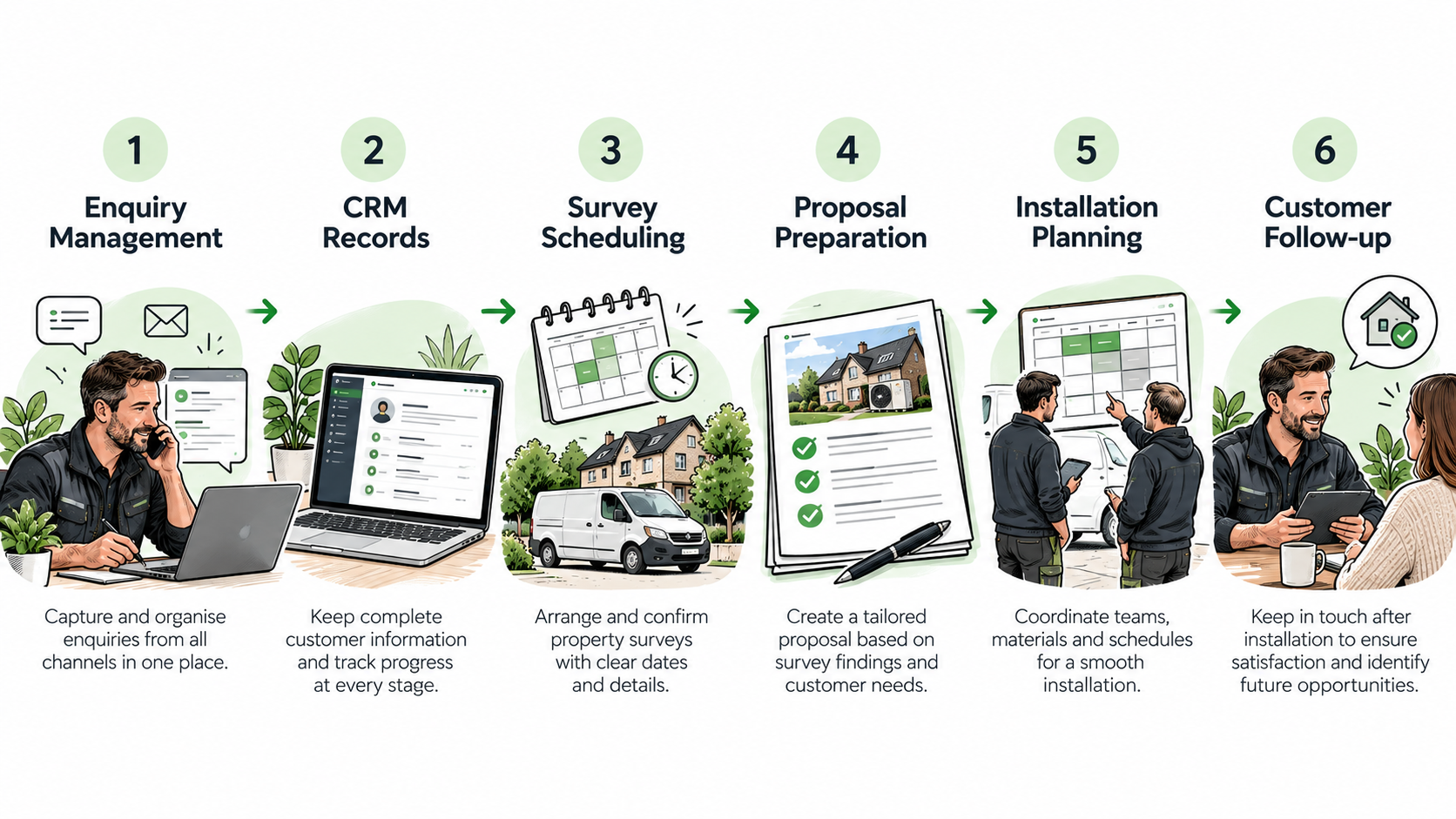
A documented workflow should explain how enquiries are recorded, which questions are asked, how surveys are arranged, when proposals are sent, how follow-ups are scheduled and how outcomes are updated.
Once the process works reliably, it becomes easier to train another team member to manage parts of the customer journey. It also gives the business a way to identify where improvements are needed.
For installers looking to grow, that repeatability matters. A pipeline managed entirely through informal messages and memory becomes harder to control as enquiry volume increases.
Keep Genuine Opportunities Moving
Long sales cycles are not necessarily a sign of poor lead quality. They can reflect the complexity of the project, the homeowner's circumstances and the time required to make a major home improvement decision.
Installers can manage that uncertainty by qualifying opportunities, documenting each stage, agreeing on next steps and making follow-up relevant to the homeowner's needs.
The objective is not to rush every prospect into a decision. It is to ensure that genuine opportunities are handled consistently and that the business can distinguish between active projects, delayed decisions and enquiries that are unlikely to proceed.
Ready to Improve Your Sales Process?
If your pipeline contains enquiries that stall, disappear or remain open without a clear next step, reviewing your sales process can help identify where opportunities are being lost.
Frequently Asked Questions
How often should a heat pump installer follow up?
There is no universal schedule for every prospect. Follow-up should reflect the homeowner's stated timeline, the stage of the process and any agreed next steps. Record each interaction so that contact remains relevant.
Should slow-moving leads be removed from the pipeline?
Not automatically. Record whether the project is delayed, awaiting information or no longer active. This keeps reporting accurate and helps the business prioritise its time.
Why do heat pump prospects delay their decisions?
Possible reasons include uncertainty about total project costs, technical requirements, renovation timing, comparison with other proposals or a need to discuss the decision with others. The installer should establish the actual reason rather than assume it.
What is the most important follow-up improvement?
Make sure every active opportunity has a clear status and a defined next action. This reduces the likelihood that genuine opportunities are forgotten.