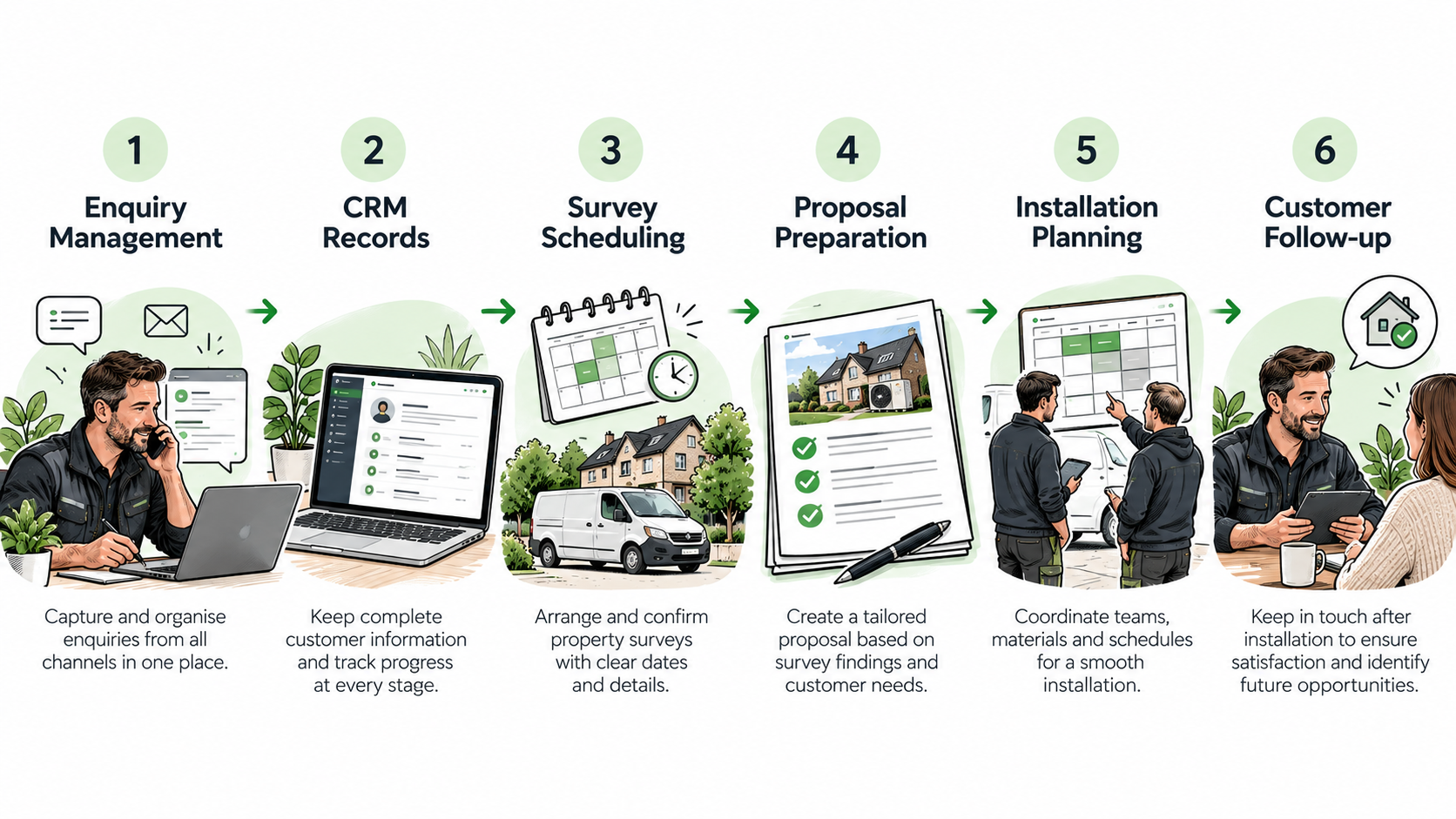
Growth Starts With Understanding Current Capacity
Growing a solar or heat pump installation business creates a challenge that is easy to overlook: generating more demand does not automatically create the capacity to fulfil it.
An installer may become more effective at attracting enquiries and booking surveys, yet still struggle to prepare proposals, coordinate appointments and complete installations on time. The owner can end up handling sales, design, administration, customer communication and operational decisions simultaneously.
At first, this may feel like a natural part of building a business. Over time, however, the same habits can become a constraint.
The meeting transcript illustrates this tension. The business discussed had opportunities progressing through the sales pipeline, but the owner was also balancing surveys, follow-up, installation capacity and administrative responsibilities. The conversation raised a wider question: how can an installation company grow without creating a workload that becomes difficult to manage?
The answer is not simply to generate more leads or hire more people. Sustainable growth requires the sales process, operational systems and delivery capacity to develop together.
Before increasing marketing activity, installers need a realistic picture of how much work the business can deliver.
That means understanding more than the number of surveys the owner can attend. The complete process includes qualifying enquiries, conducting surveys, preparing proposals, securing deposits, ordering equipment, scheduling installation teams, completing work and handling aftercare.
A business may have capacity at one stage but a bottleneck at another.
For example, the owner may be able to conduct additional surveys each week, but if proposals take too long to prepare, those surveys can create a growing backlog. Alternatively, the sales pipeline may be healthy while installation teams are already committed for several months.
These situations require different responses. The first may call for better proposal workflows or administrative support. The second may require changes to scheduling, labour capacity or the way future work is accepted.
Installers should map the stages of their current process and identify where delays occur before making major decisions about growth.
More Leads Can Create an Operational Bottleneck
Marketing and sales are often treated as separate from installation operations. In practice, they are closely connected.
Every additional enquiry creates work. Suitable leads need to be qualified, surveys need to be arranged, proposals need to be prepared and homeowners need updates. If more projects are sold than the business can deliver, customers may face long waits between agreeing to proceed and receiving their installation.
Long lead times are not automatically a problem. They may reflect strong demand or the seasonal nature of the business. The risk arises when the business cannot communicate realistic dates or maintain confidence while customers wait.
A homeowner who commits to an installation expects clear information about the next stages. If dates repeatedly change or communication becomes inconsistent, the customer experience can suffer.
This is why sales activity should be considered alongside delivery capacity. The objective is not to stop generating demand whenever the diary becomes busy. It is to understand how much demand the business can responsibly accept and what changes would allow it to deliver more.
Plan Capacity Before Increasing Marketing Spend
Installers should periodically compare the sales pipeline with the installation schedule.
The pipeline indicates the work that may arrive, while the schedule shows the work the business has already committed to delivering. Neither should be treated as a perfect forecast, but together they can help the owner understand likely pressure points.
For example, a business may have several proposals awaiting decisions while its installation teams are already heavily booked. If those proposals convert, the business needs to know whether the work can be scheduled within an acceptable timeframe.
This is an opportunity to consider practical options before the pressure becomes urgent.
The company might improve the scheduling process, group projects geographically, introduce more reliable subcontractor arrangements or recruit for a clearly defined capacity gap. In some circumstances, it may need to moderate marketing activity until the operational position improves.
The right decision depends on project margins, delivery requirements, available labour and the owner's growth objectives. The important point is to make the decision deliberately rather than discovering the capacity problem after customers have committed.
Use CRM and Calendar Systems as a Single Source of Truth
The meeting also highlighted the difficulty of managing customer information across different communication channels. When important details are spread across WhatsApp conversations, calendars and a CRM, it becomes easier to miss an appointment, overlook a follow-up or lose track of the latest project information.
A customer relationship management system should help the business maintain a reliable record of each opportunity. It does not need to be complicated, but it should be clear where the team records the information that matters.
At a minimum, the business should be able to see the customer's contact details, enquiry source, project requirements, current sales stage, survey date, proposal status and next action.
Appointment information should also be consistent. If a meeting is rescheduled, the change should be reflected in the calendar and the relevant customer record. Team members should know which system is authoritative rather than relying on whichever message they saw most recently.
The purpose is not to eliminate every message or conversation. It is to prevent important operational information from being trapped in disconnected channels.
Document the Process Before Delegating It
Delegation is difficult when the process exists mainly in the owner's head.
If the owner is the only person who knows how enquiries should be qualified, how surveys should be arranged, which information belongs in a proposal or when customers should be contacted, every task eventually returns to them.
Simple standard operating procedures can reduce this dependency.
A useful procedure explains what triggers a task, who is responsible, what information is needed, which steps must be completed and how the result should be recorded. Screenshots, templates and checklists can make the instructions easier to follow.
The first version does not need to be perfect. Start with recurring tasks that consume time or create the greatest risk when missed.
For example, document the process for recording a new enquiry, confirming a survey, preparing a post-survey summary or following up on a proposal. Review the procedure after someone else has used it, then improve any unclear steps.
This approach helps the business build repeatable operations without requiring the owner to design a complete management system before delegating anything.
Delegate Tasks That Do Not Require the Owner's Expertise
Owners often remain involved in administrative work because they know the business best. That can be understandable in the early stages, but it also limits the time available for activities that genuinely require their judgement.
The goal is not to delegate every task indiscriminately. It is to identify which activities require technical expertise or commercial decision-making and which can be completed by a trained team member using a clear process.
Appointment confirmation, record updates, document organisation and routine follow-up may be suitable for delegation once the required information and standards are documented. Technical assessments and complex recommendations may still require a qualified professional.
Delegation should also include a clear method for escalating exceptions. A team member should know what to do when information is missing, a homeowner changes the scope or an appointment cannot be accommodated.
When responsibilities are defined, the owner can spend less time monitoring every small task and more time improving the business.
Consider Hiring and Partnerships Carefully
Hiring can increase capacity, but it also introduces costs and responsibilities. A new employee may require training, management, equipment and a reliable flow of work. Recruiting too early can place pressure on cash flow, while waiting too long can restrict growth or create an unsustainable workload.
Installers should identify the specific constraint they are trying to solve before committing to additional payroll.
If the bottleneck is administration, another installer may not solve it. If the company has enough qualified sales opportunities but cannot deliver installations, additional operational capacity may be more relevant. If the owner spends too much time on low-value coordination, better systems or administrative support may create room for growth.
Partnerships and subcontractors may provide flexibility in some situations, but they require appropriate checks, clear responsibilities and quality controls. Any arrangement should reflect the technical, safety and contractual requirements of the work.
The aim is to build capacity that fits the business's actual needs rather than hiring simply because growth is desirable.
Build a Business That Can Operate Without Constant Owner Intervention
A useful test of operational maturity is whether routine activities can continue when the owner is unavailable.
This does not mean the business should operate without leadership. It means that a customer appointment should not be lost because only one person knows the details, and a follow-up should not be missed because the owner is away from their laptop.
Reliable records, documented procedures, clear task ownership and a consistent calendar all reduce this dependency.
The owner can begin by identifying the tasks that repeatedly interrupt their work. If the same questions arise every week, the process may need clarification. If appointments regularly require manual checking across several channels, the calendar workflow may need improvement. If proposals are delayed because the owner has too many competing responsibilities, the business may need to simplify or delegate parts of the process.
Small operational improvements can create more capacity without immediately adding headcount.
Review the Numbers That Connect Sales and Delivery
A business should not evaluate growth exclusively through lead volume or the value of proposals issued.
Useful operational measures may include the number of qualified enquiries, surveys completed, proposals outstanding, deposits received, installations scheduled and jobs completed. The time taken to move between stages can reveal where work is accumulating.
The business should also review how much installation capacity is available over the coming weeks and months. This makes it easier to compare potential sales with the resources needed to deliver them.
Targets should reflect the company's own operating model. A revenue goal, such as the monthly sales target discussed during the meeting, is not meaningful in isolation. It must be considered alongside project values, margins, delivery capacity, cash flow and the timing of completed work.
A full pipeline can be encouraging, but it is not the same as completed revenue. Likewise, a busy installation schedule does not automatically indicate healthy margins or an efficient process.
The value of measurement is that it connects the business's ambitions with the practical requirements of delivering the work.
Scale the Whole Business, Not Just the Lead Flow
Sustainable growth requires more than increasing the number of enquiries. It depends on the business's ability to qualify opportunities, manage appointments, prepare proposals, communicate with customers and deliver installations consistently.
For some installers, the next improvement will be a better CRM process. For others, it may be documenting routine work, delegating administration or addressing a genuine installation-capacity constraint.
The starting point is to identify where the business currently loses time and where additional demand would create pressure. From there, the owner can prioritise improvements that support both sales and delivery.
Growth should create a stronger business, not simply a busier owner.
Ready to Identify Your Next Growth Bottleneck?
If your business is generating opportunities but struggling to manage the workload, a structured review can help identify where your sales process, systems or delivery capacity need attention.
Frequently Asked Questions
How do I know whether my installation business is ready to scale?
Review the complete customer journey, from enquiry handling to completed installation. If routine tasks are regularly delayed, information is difficult to locate or customers receive inconsistent updates, strengthen those processes before increasing demand significantly.
Should I hire more installers when demand increases?
Not automatically. First identify the actual bottleneck. It may be installation labour, administration, quoting, scheduling or sales follow-up. Choose a solution that addresses the constraint and remains financially sustainable.
What should a CRM track for a solar or heat pump business?
At a minimum, record contact details, enquiry source, project requirements, sales stage, appointments, proposal status and the next action. The system should provide a reliable view of the opportunity without requiring the team to search through multiple channels.
How can I reduce the business's dependence on the owner?
Document recurring processes, assign clear responsibilities, establish escalation rules and delegate appropriate tasks. Start with activities that are repetitive and relatively easy to standardise.
Is it better to hire employees or use subcontractors?
That depends on the work required, expected demand, quality-control needs, cash flow and the responsibilities associated with each arrangement. Compare the options carefully and ensure that any partnership meets the business's technical and operational requirements.