The Headline Price Only Tells Part of the Story
When comparing lead-generation providers, the price per enquiry is an obvious place to start. One supplier may offer leads at a lower price than another, making the cheaper option appear to provide better value.
However, the price paid to acquire an enquiry is only one part of the cost of turning that enquiry into an installation.
Someone still needs to contact the homeowner, establish the project's suitability, arrange a survey, travel to the property, prepare a proposal and follow up. If the enquiry is irrelevant or the homeowner's expectations do not match the service, much of that work may produce no sale.
For solar and heat pump installers, this distinction is important. A low-cost enquiry can become expensive when it consumes time without creating a realistic opportunity. A more expensive enquiry may be worthwhile if it consistently produces suitable projects, although that must be established through the business's own results rather than assumed from the price.
The practical question is not simply, “How much does this lead cost?” It is, “What does it cost our business to turn this type of enquiry into a completed, commercially viable installation?”
Why the Headline Price Can Be Misleading
The price per lead gives an immediate figure, but it does not describe the quality of the enquiry or the amount of work needed to progress it.
A lead might relate to the wrong technology, an unsuitable location or a homeowner whose expectations are incompatible with the installation business's offer. Another might be relevant but require extensive explanation before the homeowner understands the likely scope of the project.
The meeting transcript included an example of an enquiry that concerned air conditioning rather than a heat pump. Although both relate to heating, cooling or indoor comfort, they are not interchangeable services. An installer whose business focuses on heat pumps may spend time reviewing and responding to an enquiry that does not match the intended offering.
The issue is not necessarily that every lead from a particular provider is poor. One mismatch cannot establish the overall quality of a source. The important point is that technology relevance should be measured rather than assumed.
Before comparing suppliers, installers should define what constitutes an acceptable enquiry. That might include the technology requested, location, property type, homeowner intent and whether the contact details and project information are usable.
Without those criteria, the business may compare prices for enquiries that are fundamentally different.
Calculate the Cost of Handling an Enquiry
Lead handling involves more than the initial response.
Depending on the project and sales process, staff may need to make several contact attempts, ask qualification questions, review photographs or property information, schedule a survey and prepare notes for the next stage.
If the installer is also responsible for site visits, design, quoting and administration, this time comes directly out of the hours available for other activities.
A practical assessment starts by recording the work involved in managing enquiries from each source. The purpose is not to create an unnecessarily complicated accounting exercise. It is to make previously invisible effort easier to understand.
For example, a business might track:
- The amount paid for each enquiry.
- Time spent contacting and qualifying the homeowner.
- Time spent arranging and attending surveys.
- Travel and other direct expenses.
- Time spent preparing proposals.
- Follow-up time before a decision is reached.
- The eventual outcome, including whether the project was suitable.
The figures will vary by business. Some installers may be able to automate parts of their process, while others rely on the owner to manage nearly every stage. The useful comparison is the one that reflects the actual operation.
Survey Costs Deserve Particular Attention
A survey can be an essential step in understanding a property, but it also requires time and resources.
The cost may include travel, the time spent on site, preparation beforehand and the administrative work needed afterwards. A survey that identifies a viable project may be a productive investment. A visit to a property that was clearly outside the service area or based on incorrect expectations may have been avoidable.
This does not mean every uncertain enquiry should be rejected before a visit. Some technical questions cannot be answered properly without assessing the property. Rather, the objective is to gather enough information beforehand to make the decision to survey an informed one.
Installers can explain which information is needed before a visit and ask homeowners to provide it where practical. Photographs, existing-system details, postcode and a description of the intended work may help determine whether a survey is appropriate, although they do not replace necessary technical checks.
When a visit is needed, the installer should also make clear what the survey will cover and what additional information may be required before a final recommendation can be made.
Measure Cost Against Outcomes, Not Just Enquiries
The most useful lead-generation measurement connects acquisition cost with the progress and outcomes of the sales process.
Cost per lead is easy to calculate, but it does not show how many enquiries become surveys, proposals or installations. Those later stages provide additional context.
Consider two hypothetical sources. Source A supplies many inexpensive enquiries, but a large proportion request services the installer does not provide. Source B supplies fewer enquiries, but more of them fit the service area and intended technology.
It would be premature to conclude that Source B is better simply because its leads look more relevant. The installer should compare actual costs, handling time and commercial outcomes over a meaningful period. Equally, it would be a mistake to choose Source A solely because its headline price is lower.
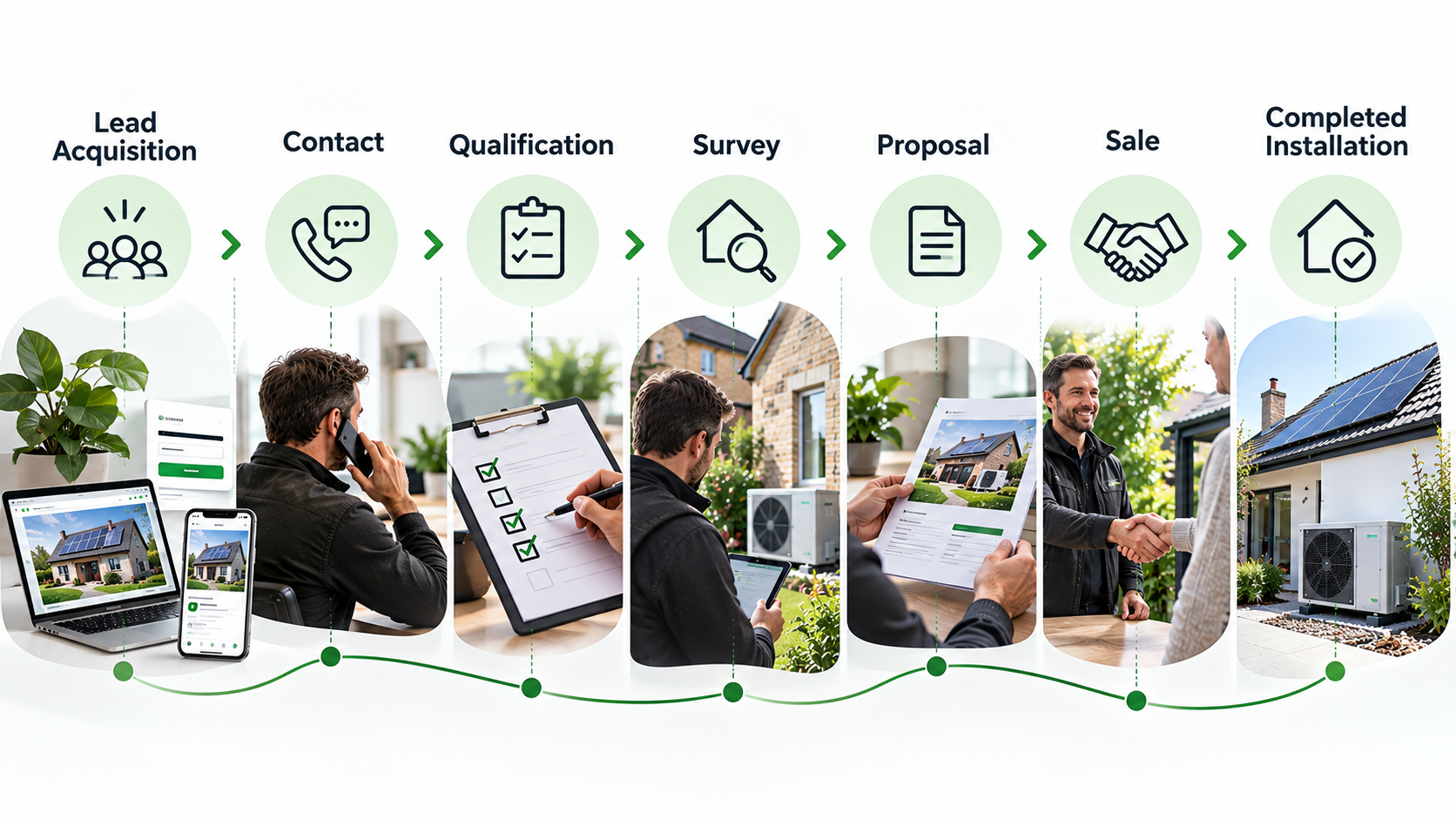
A useful measurement framework follows the enquiry through several stages:
Enquiry received → Contact made → Qualified → Survey completed → Proposal issued → Sale confirmed → Installation completed.
The business can then investigate where different lead sources perform well or poorly.
For example, if a source generates relevant enquiries but very few homeowners respond, the issue may involve contact details, timing or the follow-up process. If homeowners are contacted but repeatedly fail qualification, the marketing targeting or the provider's definition of a lead may need attention.
If proposals are issued but few are accepted, the answer may not be to change the lead provider immediately. The business may need to review project fit, proposal clarity, price positioning, customer confidence or how the survey findings are explained.
Distinguish Marketing Problems From Sales Problems
It is tempting to blame the lead provider whenever an enquiry fails to become a sale. In reality, the outcome may be influenced by several parts of the business.
A mismatch between the advertised service and the enquiry is a lead relevance issue. A slow response may be a process issue. An unclear proposal may be a sales communication issue. A project that cannot be installed for several months may reflect an operational capacity issue.
These problems require different solutions.
The meeting transcript illustrates why lead generation, sales management and installation capacity should be considered together. Even when a business receives opportunities, the owner must still manage surveys, quotes, follow-up and the work required to deliver completed projects.
A business that changes suppliers without understanding its own sales process may simply reproduce the same problems with a different source of enquiries.
The first step is to gather enough information to identify the likely cause.
Evaluate Providers With Clear Expectations
Before working with a lead provider, installers should establish what the provider considers a qualified lead, which technologies and locations are covered, what information is supplied and how irrelevant enquiries are handled.
It is also worth clarifying how duplicate enquiries, invalid contact details and requests for unrelated services are treated under the provider's terms.
These conversations help avoid disagreements later. They also create a clearer basis for evaluating the provider's performance.
Installers should review results regularly rather than relying on isolated examples. A small number of enquiries may not provide enough evidence to make a confident judgement, particularly when projects have long sales cycles.
The review should distinguish confirmed installations from open opportunities and early-stage enquiries. It should also account for the time required for a project to progress.
The Real Cost Is the Full Journey
The cheapest lead is not automatically the most profitable, and the most expensive lead is not automatically the best.
Installers need to consider relevance, handling time, travel, survey requirements, proposal preparation and the commercial outcome. When these factors are measured together, decisions about marketing expenditure become more informed.
The goal is not to eliminate every unsuccessful enquiry. That is unrealistic in a complex sales process. It is to understand which sources create worthwhile opportunities and where the business can reduce avoidable effort.
Want a Clearer View of Your Lead Performance?
If you're unsure whether your marketing is producing suitable opportunities, reviewing your lead journey can help you identify where cost, time and sales performance need closer attention.
Frequently Asked Questions
Is a cheaper solar lead always better value?
No. The headline price does not reflect how much work is required to qualify the enquiry or whether it eventually produces a viable installation. Compare lead cost with relevance, handling time and sales outcomes.
What should solar and heat pump installers track?
Track the source, acquisition cost, contact attempts, qualification result, survey status, proposal status and eventual outcome. Where possible, record handling time and direct costs as well.
How long should installers evaluate a lead provider?
Use a period long enough to observe meaningful progression through the sales process. Because projects can take months to develop, avoid judging a provider exclusively by very recent enquiries or by a small number of outcomes.
What if leads are relevant but still do not convert?
Review the stages after the enquiry arrives. Contact speed, homeowner expectations, survey quality, proposal clarity, follow-up and available installation dates may all influence the result.